
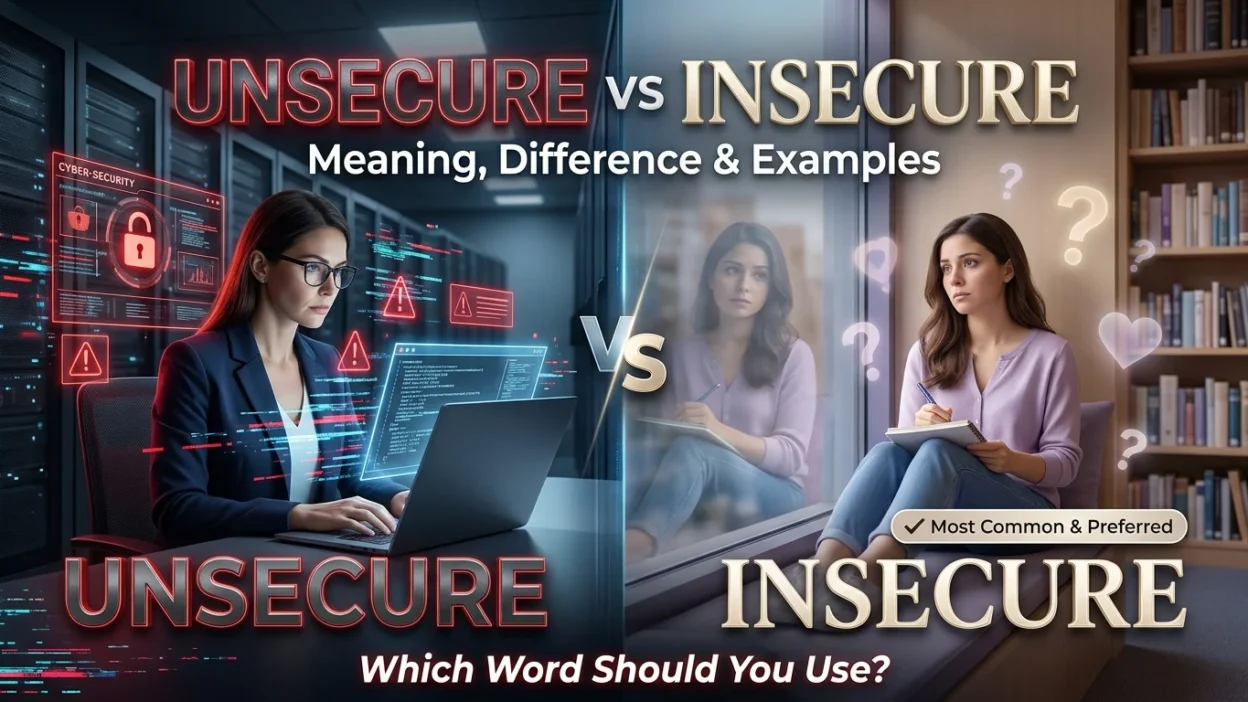
Are you confused about whether to use unsecure or insecure? Both words are related to a lack of security, safety or protection but they are not always used in the same way. Choosing the right word can make your English clearer and more natural.
The word insecure is much more common in modern English. It can describe something that is unsafe or not properly protected, as well as a person who feels uncertain or lacks confidence. Unsecure is also a real word but it is less common and usually refers to something that is not secure. In this guide, you will learn the meanings, differences, examples and common mistakes associated with these two words.
Quick Answer: Unsecure vs Insecure
Insecure is the more common and widely preferred word. It can describe a person who lacks confidence or something that is not safe or protected.
Unsecure also means not secure, but it is less commonly used and may sound unnatural in many contexts.
- Insecure: She feels insecure about her appearance.
- Insecure: The website uses an insecure connection.
- Unsecure: The equipment was left unsecure.
Quick tip: Use insecure in most situations unless a specific technical or stylistic context calls for unsecure.
Why Do People Confuse Unsecure and Insecure?
People confuse these words because both begin with prefixes that express the opposite of something.
- Un- often means not or the opposite of.
- In- can also mean not or the opposite of.
Both prefixes can change the meaning of an adjective. For example:
- Happy → Unhappy
- Complete → Incomplete
- Secure → Insecure
- Secure → Unsecure
Because both words are connected to the adjective secure, writers sometimes wonder whether they can use them interchangeably.
1. What Does Insecure Mean?
Insecure is an adjective that means not safe, not protected, uncertain, or lacking confidence.
It has two common uses:
A. Insecure Meaning Not Safe or Protected
Use insecure when something is not properly protected against danger, damage, theft, or unauthorized access.
Examples:
- The building has an insecure entrance.
- This website uses an insecure connection.
- The workers noticed an insecure electrical system.
- Leaving the door unlocked makes the house insecure.
- The company needs to improve its insecure network.
B. Insecure Meaning Lacking Confidence
Use insecure to describe someone who feels uncertain, worried, or unsure about themselves.
Examples:
- She feels insecure about her appearance.
- He became insecure after receiving negative comments.
- The new student felt insecure in class.
- Sometimes I feel insecure when speaking English.
- An insecure person may worry too much about others’ opinions.
2. What Does Unsecure Mean?
Unsecure is an adjective that means not secure, safe, or protected. It is a valid English word, but it is less common than insecure.
It is generally used to describe something that lacks security or protection rather than a person’s emotional confidence.
Examples of Unsecure
- The equipment was left unsecure overnight.
- The workers found an unsecure storage area.
- The package remained unsecure during transportation.
- The documents were kept in an unsecure location.
- The gate was unsecure and needed repair.
- The system was considered unsecure by the technician.
- They discovered an unsecure connection during testing.
In many of these examples, insecure or a more specific word such as unsecured may sound more natural.
3. Unsecure vs Insecure: Comparison Table
| Feature | Insecure | Unsecure |
|---|---|---|
| Meaning | Not safe, protected, or confident | Not secure or protected |
| Part of speech | Adjective | Adjective |
| Commonness | Very common | Less common |
| Emotional confidence | Yes | Generally no |
| Physical safety | Yes | Yes, but less commonly |
| Technology | Common | Less common |
| Example | He feels insecure. | The equipment is unsecure. |
| General recommendation | Preferred choice | Use selectively |
4. When Should You Use Unsecure?
Use unsecure when you specifically want to express that something is not secure, although insecure or unsecured will often be more natural.
Examples:
- The equipment was left unsecure.
- The storage area remained unsecure.
- The documents were stored in an unsecure location.
In professional and technical writing, it is often better to choose a more precise alternative:
- Unsecured: Not fastened, locked, or protected.
- Insecure: Not safe, reliable, or protected.
- Vulnerable: Easily harmed, attacked, or damaged.
5. Unsecure vs Insecure: Example Sentences
Here are more examples to help you understand the difference.
| No. | Sentence | Better Choice |
|---|---|---|
| 1 | She feels ______ about her appearance. | Insecure |
| 2 | The website has an ______ connection. | Insecure |
| 3 | He became ______ after criticism. | Insecure |
| 4 | The building has an ______ entrance. | Insecure |
| 5 | I feel ______ when speaking in public. | Insecure |
| 6 | The system was found to be ______. | Insecure |
| 7 | The documents were kept in an ______ location. | Insecure / Unsecure |
| 8 | The damaged lock made the door ______. | Insecure |
| 9 | She is ______ about her abilities. | Insecure |
| 10 | The technician identified an ______ network. | Insecure |
6. Common Mistakes to Avoid
Mistake 1: Thinking Unsecure Is Always Incorrect
Incorrect belief: Unsecure is not a real English word.
Correct understanding: Unsecure is a valid word, but it is less common than insecure.
Mistake 2: Using Unsecure to Describe Emotional Confidence
Less natural: She feels unsecure about herself.
Better: She feels insecure about herself.
Use insecure when describing a person’s confidence or feelings.
Mistake 3: Confusing Insecure and Unsecured
These words are related, but they are not always interchangeable.
- Insecure: The website has an insecure connection.
- Unsecured: The bicycle was left unsecured outside.
Unsecured often describes something that has not been locked, fastened, or protected.
Mistake 4: Using Unsecure When a More Specific Word Is Better
Less natural: The door is unsecure.
More natural: The door is unlocked.
Choose words that clearly explain the situation.
7. Easy Memory Trick: How to Remember Insecure and Unsecure
Use this simple memory trick:
Insecure = Feelings and Safety
Think of someone who lacks confidence or something that is not properly protected.
Unsecure = Not Secure
It expresses the absence of security, but it is less common.
Remember:
- Insecure: The child feels insecure.
- Insecure: The website is insecure.
- Unsecure: The equipment was left unsecure.
When you are unsure, choose insecure in most situations.
8. American vs British English
Both American and British English recognize insecure and unsecure. However, insecure is much more common in both varieties.
| Expression | American English | British English |
|---|---|---|
| Insecure | Common | Common |
| Unsecure | Less common | Less common |
| Unsecured | Common | Common |
There is no major spelling difference between American and British English for these words.
9. Similar Words and Expressions
Here are some related words that can help you express different types of insecurity.
| Word | Meaning | Example |
|---|---|---|
| Unsafe | Not safe | The road is unsafe. |
| Unprotected | Without protection | The files are unprotected. |
| Unsecured | Not locked or fastened | The door was unsecured. |
| Vulnerable | Easily harmed or attacked | The system is vulnerable. |
| Uncertain | Not sure about something | She feels uncertain. |
| Anxious | Worried or nervous | He feels anxious. |
| Unstable | Not steady or reliable | The structure is unstable. |
10. Practice Questions: Unsecure or Insecure?
Choose the more natural word to complete each sentence.
- She feels ______ about her appearance.
- The website has an ______ connection.
- He became ______ after receiving criticism.
- The building has an ______ entrance.
- I feel ______ when speaking in front of people.
- The company discovered an ______ network.
- The child felt ______ in the unfamiliar environment.
- The security system is ______.
- He is ______ about his abilities.
- The technician reported an ______ system.
Answers
- Insecure
- Insecure
- Insecure
- Insecure
- Insecure
- Insecure
- Insecure
- Insecure
- Insecure
- Insecure
11. Frequently Asked Questions (FAQs)
1. Is unsecure a real word?
Yes. Unsecure is a real English adjective meaning not secure or protected. However, it is less common than insecure.
2. Which is correct: unsecure or insecure?
Both words are valid, but insecure is generally the more natural and widely used choice. Use it for emotional confidence, physical safety, and digital security.
3. Can insecure describe a person?
Yes. Insecure commonly describes someone who lacks confidence or feels uncertain about themselves.
Example: She feels insecure about her abilities.
4. Can unsecure describe a person?
It is not the usual choice when describing someone’s emotional confidence. Use insecure instead.
5. Is unsecure the opposite of secure?
Yes. Unsecure can mean not secure. However, insecure is the more common opposite of secure in everyday English.
6. What is the difference between insecure and unsecured?
Insecure means not safe, reliable, or protected. Unsecured usually means not locked, fastened, or protected against loss or access.
Example: The website is insecure. The bicycle was left unsecured.
7. Is insecure a negative word?
Yes. It generally describes a lack of confidence, safety, or protection. However, it is a neutral descriptive word rather than an insult.
8. Should I use insecure or unsecure in formal writing?
Use insecure in most formal writing because it is more widely accepted and natural. Use unsecure only when it fits a specific context or established terminology.
12. Remember This
- Insecure: The common word for lacking confidence, safety, or protection.
- Unsecure: A less common word meaning not secure.
- Unsecured: Not locked, fastened, or protected.
- Unsafe: Not safe.
- Vulnerable: Easily harmed or attacked.
The safest choice in most situations is insecure.
Conclusion
The difference between unsecure and insecure is mainly about common usage and context. Both words can describe something that is not secure, but insecure is much more common in modern English. It can describe unsafe systems, unprotected situations and people who lack confidence.
Use insecure for most everyday, academic and professional writing. Remember that unsecure is also valid but it is less common. When describing something that is not locked or fastened, consider using unsecured for greater clarity.