
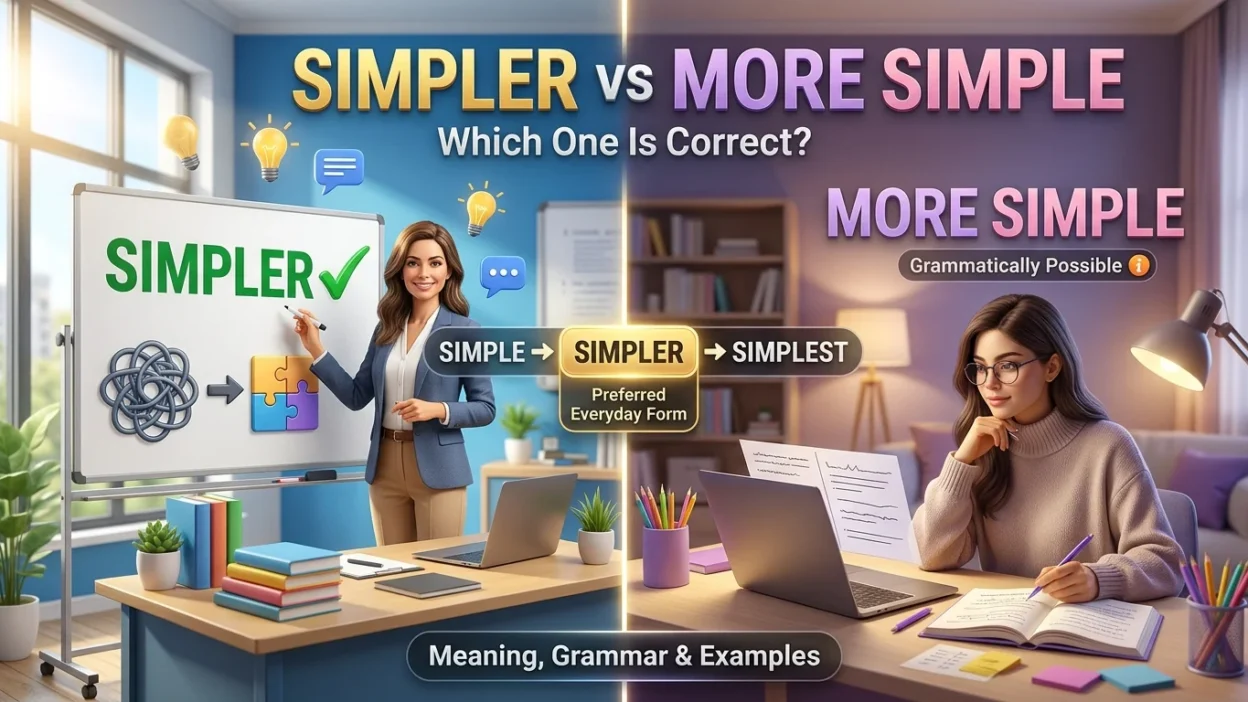
Are you unsure whether to write simpler or more simple? Both expressions are used in English, and both can communicate the idea of something being less complicated or easier to understand. However one is much more common in everyday English.
The word simple is an adjective, and its comparative form is usually simpler. We use it when comparing two things, ideas, methods or situations. The phrase more simple can also be correct in certain contexts, especially when a writer wants to emphasize the degree of simplicity or create a particular rhythm. In this guide, you will learn the difference between simpler and more simple, discover when to use each expression and explore practical examples to improve your English.
Quick Answer: Simpler vs More Simple
Simpler is the usual and more natural comparative form of simple. It means less complicated or easier than something else.
More simple is also grammatically possible, but it is less common. It may be used for emphasis or in particular writing styles.
- Correct and natural: This explanation is simpler.
- Also possible: This explanation is more simple.
In most everyday situations, choose simpler.
Why Do People Confuse Simpler and More Simple?
People confuse these expressions because English uses two common ways to form comparative adjectives:
- Add -er to an adjective.
- Put more before an adjective.
For example:
- Small → Smaller
- Beautiful → More beautiful
- Difficult → More difficult
- Simple → Simpler
The confusion happens because simple ends in the letter E, but its usual comparative form still takes -r.
1. What Does Simpler Mean?
Simpler is the comparative form of the adjective simple. It means less complicated, easier, clearer, or more straightforward than something else.
We use it when comparing two things.
Examples of Simpler
- This method is simpler than the previous one.
- My teacher gave us a simpler explanation.
- I need a simpler way to solve this problem.
- The new design looks simpler and cleaner.
- This recipe is simpler than the one I tried yesterday.
- Can you explain it in simpler words?
- The second question is simpler than the first.
- We should choose the simpler option.
- Her writing style is simpler and easier to understand.
- This software makes difficult tasks simpler.
When to Use Simpler
Use simpler when you want to say that something is:
- Easier to understand.
- Less complicated.
- More straightforward.
- Less detailed or elaborate.
- Easier to use or complete.
2. What Does More Simple Mean?
More simple is a comparative phrase formed by placing more before the adjective simple.
It can mean the same thing as simpler: less complicated or easier to understand.
Although it is grammatically possible, it is generally less natural than simpler in everyday English.
Examples of More Simple
- We need a more simple explanation for beginners.
- The designer wanted a more simple appearance.
- Her writing became more simple over time.
- This approach offers a more simple way to organize information.
- The instructions should be more simple and direct.
- I prefer a more simple lifestyle.
- The new system provides a more simple solution.
- They decided to use a more simple design.
- The teacher suggested a more simple method.
- We are looking for a more simple way to communicate.
When to Use More Simple
You may use more simple when:
- You want to emphasize the word more.
- You are contrasting different degrees of simplicity.
- The phrase fits a particular sentence rhythm or writing style.
- You want to avoid an awkward repetition of comparative forms in a sentence.
However, in ordinary writing and conversation, simpler is usually the better choice.
3. Simpler vs More Simple: Comparison Table
| Feature | Simpler | More Simple |
|---|---|---|
| Meaning | Less complicated | Less complicated |
| Grammar | Comparative adjective | Comparative phrase |
| Naturalness | More natural | Less common |
| Everyday English | Preferred | Less frequently used |
| Formal writing | Commonly preferred | Sometimes used |
| Example | This task is simpler. | This task is more simple. |
| Recommendation | Best general choice | Use when appropriate |
4. When Should You Use Simpler?
Use simpler in most everyday and professional situations.
It is especially useful when comparing:
- Explanations
- Instructions
- Designs
- Methods
- Solutions
- Processes
- Ideas
Examples:
- This explanation is simpler than the textbook version.
- We need a simpler process for new employees.
- The updated website has a simpler design.
- Can you find a simpler solution?
- Her instructions are simpler than mine.
5. When Should You Use More Simple?
Use more simple when it provides a specific emphasis or fits the structure of your sentence.
For example:
- The goal is to make the system more simple, not necessarily more powerful.
- Some people prefer a more simple lifestyle, while others enjoy luxury.
- The second version feels more simple in tone, even though both designs contain the same information.
These sentences are understandable, but you can often replace more simple with simpler for a smoother result.
6. Simpler vs More Simple: Example Sentences
Here are more examples to help you understand how these expressions work.
| No. | Sentence | Better Choice |
|---|---|---|
| 1 | This explanation is ______ than the last one. | Simpler |
| 2 | We need a ______ way to solve the problem. | Simpler |
| 3 | The new design looks ______. | Simpler |
| 4 | Can you make these instructions ______? | Simpler |
| 5 | This method is ______ and faster. | Simpler |
| 6 | I want a ______ lifestyle. | Simpler |
| 7 | The second question is ______. | Simpler |
| 8 | This app makes learning ______. | Simpler |
| 9 | We need a ______ solution for beginners. | Simpler |
| 10 | Her explanation was ______ than mine. | Simpler |
7. Common Mistakes to Avoid
Mistake 1: Thinking More Simple Is Always Wrong
Incorrect belief: More simple is never grammatically correct.
Better understanding: More simple is possible, but simpler is generally more natural.
Mistake 2: Using Both Comparative Forms Together
Incorrect: This method is more simpler than the old one.
Correct: This method is simpler than the old one.
Do not use more and the comparative ending -er together in this construction.
Mistake 3: Forgetting the Word Than
Incorrect: This explanation is simpler the previous one.
Correct: This explanation is simpler than the previous one.
Use than when making a direct comparison.
Mistake 4: Using Simple Instead of Simpler in a Comparison
Less natural: This method is simple than the other method.
Correct: This method is simpler than the other method.
8. Easy Memory Trick: How to Remember Simpler and More Simple
Use this simple rule:
Simple → Simpler → Simplest
- Simple: The basic form.
- Simpler: The comparative form.
- Simplest: The superlative form.
Think of a comparison between two explanations:
- This explanation is simple.
- This explanation is simpler than the other one.
- This is the simplest explanation of all.
Remember that simpler is your best everyday choice when comparing two things.
9. American vs British English
There is no meaningful spelling difference between American and British English for simpler and more simple.
| Expression | American English | British English |
|---|---|---|
| Simpler | Simpler | Simpler |
| More simple | More simple | More simple |
| Simplest | Simplest | Simplest |
Both varieties generally prefer simpler in everyday English.
10. Similar Words and Expressions
Learning related comparative forms can help you understand how English adjectives work.
| Basic Adjective | Comparative Form |
|---|---|
| Simple | Simpler |
| Easy | Easier |
| Small | Smaller |
| Short | Shorter |
| Fast | Faster |
| Beautiful | More beautiful |
| Difficult | More difficult |
| Interesting | More interesting |
| Complicated | More complicated |
| Important | More important |
Notice that shorter adjectives often take -er, while longer adjectives commonly use more.
11. Practice Questions: Simpler or More Simple?
Choose the more natural expression to complete each sentence.
- This explanation is ______ than the previous one.
- We need a ______ way to organize these files.
- The new design is ______ and cleaner.
- Can you make this lesson ______?
- Her instructions are ______ to follow.
- This is a ______ solution for beginners.
- The second method seems ______.
- I want a ______ lifestyle.
- This question is ______ than the last one.
- The updated system makes everything ______.
Answers
- Simpler
- Simpler
- Simpler
- Simpler
- Simpler
- Simpler
- Simpler
- Simpler
- Simpler
- Simpler
12. Frequently Asked Questions (FAQs)
1. Is simpler or more simple correct?
Both are grammatically possible, but simpler is the usual and more natural comparative form of simple. It is the preferred choice in most situations.
2. Is more simple grammatically incorrect?
No. More simple is grammatically possible. However, it is less common than simpler and may sound awkward in ordinary conversation.
3. What is the comparative form of simple?
The usual comparative form of simple is simpler. For example: This exercise is simpler than the previous one.
4. What is the superlative form of simple?
The usual superlative form is simplest. For example: This is the simplest solution.
5. Can I use more simpler?
No. In standard English, avoid more simpler because it combines two comparative forms. Use simpler instead.
6. Is simpler more formal than more simple?
Simpler is generally more natural and concise in both formal and informal writing. More simple can work in particular contexts but is less common.
7. Do Americans and British people use simpler?
Yes. Both American and British English use simpler as the normal comparative form of simple.
8. What is another word for simpler?
Some alternatives include easier, clearer, less complicated, more straightforward, and more basic. Choose the word that best matches your intended meaning.
13. Remember This
- Simple: The basic adjective.
- Simpler: The usual comparative form.
- More simple: Grammatically possible but less common.
- Simplest: The usual superlative form.
- More simpler: Incorrect in standard English.
The safest rule is to use simpler in most sentences.
Conclusion
Both simpler and more simple can express the idea of something being less complicated. However, simpler is the standard comparative form and sounds more natural in everyday English. It is also the better choice for most professional, academic and general writing.
Remember the pattern: simple, simpler, simplest. If you are unsure which expression to choose, use simpler. It is clear, concise and widely accepted.