
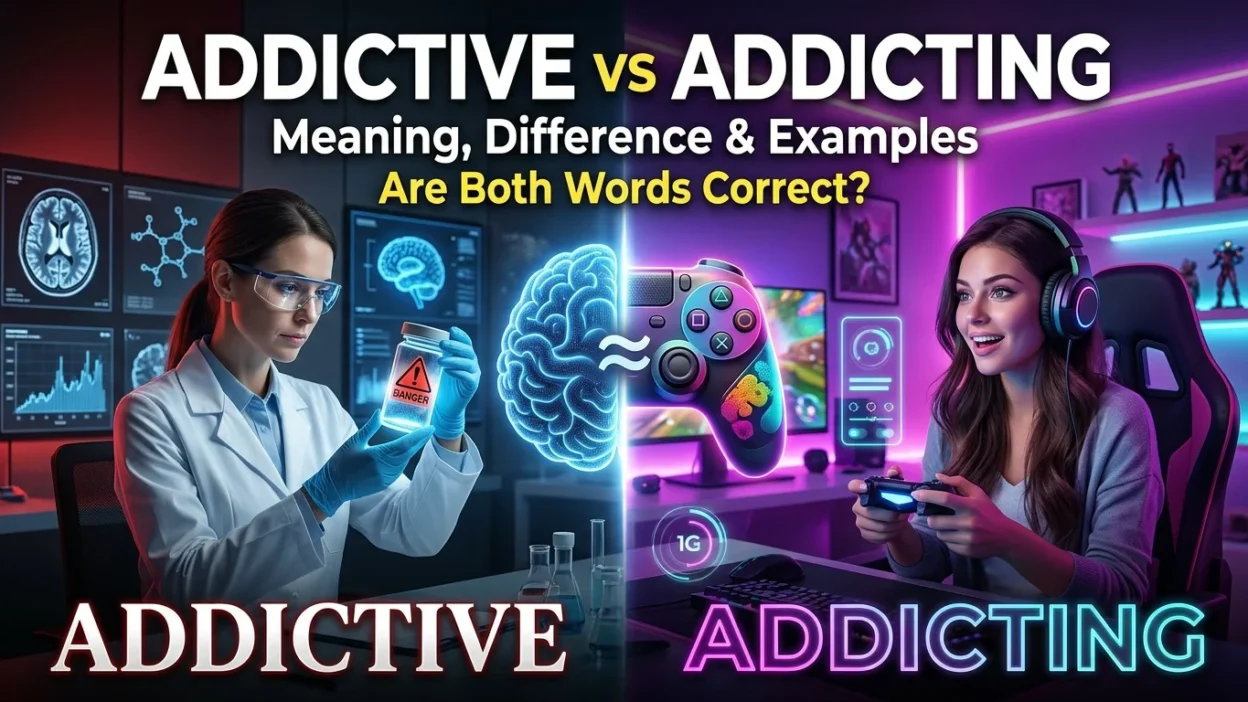
Have you ever wondered whether to say addictive or addicting? Both words describe something that makes you want more of it but they are not always used in exactly the same way. You may hear people say that a video game is addicting or that coffee is addictive. So which word is correct?
The good news is that both addictive and addicting are correct English words. They can describe something that creates a strong desire to continue using, doing or experiencing it. However, addictive is more established and widely used, especially in medical and formal contexts. Addicting is common in everyday conversation, particularly in American English. In this guide, you will learn their meanings, differences, examples and common mistakes.
Quick Answer: Addictive vs Addicting
- Addictive: Something that causes or encourages addiction or a strong desire to continue using or doing it.
- Addicting: Something that makes you want to keep using, doing or experiencing it.
Both are correct and their meanings often overlap.
Examples:
- This game is highly addictive.
- This game is really addicting.
- Nicotine is addictive.
- The new television series is addicting.
Quick tip: Use addictive in formal, medical, and general writing. Addicting is also natural, especially in casual conversation.
Why Do People Confuse Addictive and Addicting?
Both describe something that encourages repeated use or creates a strong desire to continue an activity.
The difference is mainly related to word formation and usage:
- Addictive is an adjective that describes something capable of causing addiction.
In everyday English, the two words are often interchangeable.
1. What Does Addictive Mean?
Addictive is an adjective that describes something capable of causing addiction or creating a strong, difficult to control desire to continue using or doing it.
It is commonly used when discussing substances, habits, activities, and behaviors.
Examples of Addictive
- Nicotine is highly addictive.
- Some drugs can be extremely addictive.
- Online gaming can become addictive.
- Social media can develop into an addictive habit.
- The substance has addictive properties.
- Gambling can become addictive for some people.
- The doctor explained the risks of addictive substances.
- Excessive use of certain medications can lead to dependence.
When to Use Addictive
Use addictive when discussing:
- Substances that can cause addiction.
- Habits that become difficult to control.
- Activities that encourage repeated behavior.
- Medical and psychological topics.
- Formal and academic writing.
2. What Does Addicting Mean?
Addicting is an adjective that describes something that makes people want to continue doing, using, or experiencing it.
It is especially common in informal conversations about entertainment, food, games, and activities.
Examples of Addicting
- This mobile game is so addicting.
- That new television series is really addicting.
- The chocolate dessert is surprisingly addicting.
- I found the puzzle game extremely addicting.
- This song is so addicting that I keep playing it.
- The new application has an addicting design.
- That mystery novel is completely addicting.
- The video game is fun and addicting.
When to Use Addicting
Use addicting when describing:
- Entertaining video games.
- Television shows and movies.
- Music and songs.
- Interesting books.
- Food and snacks.
- Activities that make people want to continue.
It is especially natural in casual American English.
3. Addictive vs Addicting: Comparison Table
| Feature | Addictive | Addicting |
|---|---|---|
| Meaning | Capable of causing addiction | Making someone want more |
| Part of speech | Adjective | Adjective / present participle |
| Grammar | Established adjective | Present participle used as an adjective |
| Commonness | More established and widely used | Common in informal English |
| Medical writing | Preferred | Less commonly preferred |
| Casual conversation | Common | Very common |
| Example | Nicotine is addictive. | This game is addicting. |
4. When Should You Use Addictive?
Use addictive when you want to describe something that can cause addiction or dependence.
It is particularly appropriate in formal, medical, scientific and educational writing.
Examples:
- Nicotine is an addictive substance.
- Certain drugs have addictive effects.
- The doctor discussed the risks of addictive medications.
- Gambling can become an addictive behavior.
- Some people struggle with addictive habits.
5. When Should You Use Addicting?
Use addicting when describing something that is highly engaging or makes people want to continue experiencing it.
It is common in informal conversations and entertainment reviews.
Examples:
- This game is so addicting.
- The series has an addicting storyline.
- I cannot stop listening to this addicting song.
- The puzzle is simple but addicting.
- This recipe makes an addicting snack.
6. Addictive vs Addicting: Example Sentences
Here are more examples to help you understand how both words work.
| No. | Sentence | Better Choice |
|---|---|---|
| 1 | Nicotine is highly ______. | Addictive |
| 2 | This mobile game is really ______. | Both |
| 3 | The doctor discussed the risks of ______ substances. | Addictive |
| 4 | That television series is so ______. | Both |
| 5 | Some drugs can be extremely ______. | Addictive |
| 6 | This puzzle game is surprisingly ______. | Both |
| 7 | The substance has ______ properties. | Addictive |
| 8 | I cannot stop playing this ______ game. | Both |
| 9 | Gambling can become an ______ behavior. | Addictive |
| 10 | This song has an ______ rhythm. | Both |
7. Common Mistakes to Avoid
Mistake 1: Thinking Addicting Is Incorrect
Incorrect belief: Addicting is not a real English word.
Correct understanding: Addicting is a valid English word and is commonly used as an adjective.
Mistake 2: Thinking Addictive and Addicting Always Have Different Meanings
Both words can describe something that makes people want to continue using or doing it. Their meanings overlap significantly.
Mistake 3: Using Addicting in Formal Medical Writing
Less preferred: The substance has highly addicting properties.
Better: The substance has highly addictive properties.
Use addictive when discussing medical risks, addiction, and dependence.
Mistake 4: Confusing Addictive With Addicted
These words have different meanings:
- Addictive: Something that can cause addiction.
- Addicted: A person who has developed an addiction or strong dependence.
Examples:
- Nicotine is addictive.
- He is addicted to nicotine.
8. Easy Memory Trick: How to Remember Addictive and Addicting
Use this simple memory trick:
Addictive = Addiction
Think about substances, habits, and behaviors that can cause addiction.
Addicting = Attracting You to More
Think about a game, song, or television series that makes you want to continue enjoying it.
Remember:
- Addictive: Nicotine is addictive.
- Addicting: This game is addicting.
- Addicted: He is addicted to gaming.
This simple distinction can help you choose the right word.
9. American vs British English
Both addictive and addicting are used in American and British English. However, their frequency and preferred contexts may vary.
| Expression | American English | British English |
|---|---|---|
| Addictive | Very common | Very common |
| Addicting | Common, especially informally | Used, but often less preferred |
| Addicted | Very common | Very common |
In both varieties, addictive is the safer choice for formal and medical writing.
10. Similar Words and Expressions
Here are some related words that can help you expand your vocabulary.
| Word | Meaning | Example |
|---|---|---|
| Addicted | Having an addiction | He is addicted to gambling. |
| Habit-forming | Likely to become a habit | The substance can be habit-forming. |
| Compulsive | Difficult to control | She has a compulsive habit. |
| Captivating | Extremely interesting | The story is captivating. |
| Engaging | Holding attention | The game is engaging. |
| Fascinating | Extremely interesting | The documentary is fascinating. |
| Obsessive | Involving excessive interest | He developed an obsessive interest. |
11. Practice Questions: Addictive or Addicting?
Choose the more appropriate word to complete each sentence.
- Nicotine is highly ______.
- This video game is really ______.
- The doctor explained the dangers of ______ substances.
- That television series is so ______.
- Some drugs can be extremely ______.
- This puzzle is surprisingly ______.
- The substance has ______ properties.
- I cannot stop watching this ______ show.
- Gambling can become an ______ behavior.
- The song has an ______ rhythm.
Answers
- Addictive
- Addicting
- Addictive
- Addicting
- Addictive
- Addicting
- Addictive
- Addicting
- Addictive
- Addicting
12. Frequently Asked Questions (FAQs)
1. Is addictive or addicting correct?
Both are correct English words. Addictive is more established and widely used, while addicting is especially common in informal conversations.
2. What is the difference between addictive and addicting?
Both describe something that encourages repeated use or creates a strong desire to continue. Addictive is more common in formal and medical contexts, while addicting is often used casually.
3. Is addicting a real word?
Yes.
4. Is addicting more common in American English?
It is particularly common in informal American English. However, it is also understood and used in British English.
5. Can food be addictive or addicting?
Yes. People commonly use both words to describe foods they strongly crave or find difficult to stop eating. However, describing a food as addictive does not automatically mean it causes a clinical addiction.
6. Should I use addictive or addicting in formal writing?
Use addictive in most formal, academic, scientific, and medical writing because it is more established and widely accepted in these contexts.
7. What is the difference between addicted and addictive?
Addictive describes something that can cause addiction, while addicted describes a person who has developed an addiction.
Example: The substance is addictive, and he is addicted to it.
8. Is addicting the same as interesting?
No. Interesting means something attracts attention, while addicting suggests a strong desire to continue doing or experiencing it.
13. Remember This
- Addictive: Capable of causing addiction or dependence.
- Addicting: Making someone want to continue using or experiencing something.
- Addicted: Having an addiction or dependence.
- Formal writing: Prefer addictive.
- Casual conversation: Both addictive and addicting are natural.
Conclusion
The difference between addictive and addicting is small because both words can describe something that makes people want more. However, addictive is the more established adjective and is preferred in medical, scientific and formal writing. Addicting is also correct and sounds natural in casual conversations, especially when describing games, songs, movies and entertainment.
Remember that both words are acceptable, but context matters. Use addictive when discussing addiction and dependence and feel free to use addicting in everyday descriptions of engaging experiences.

Logan Liam is the administrator of SmiliesHive, managing educational content about idioms, metaphors, and similes while ensuring clear, accurate, engaging, and beginner-friendly language resources for readers worldwide.