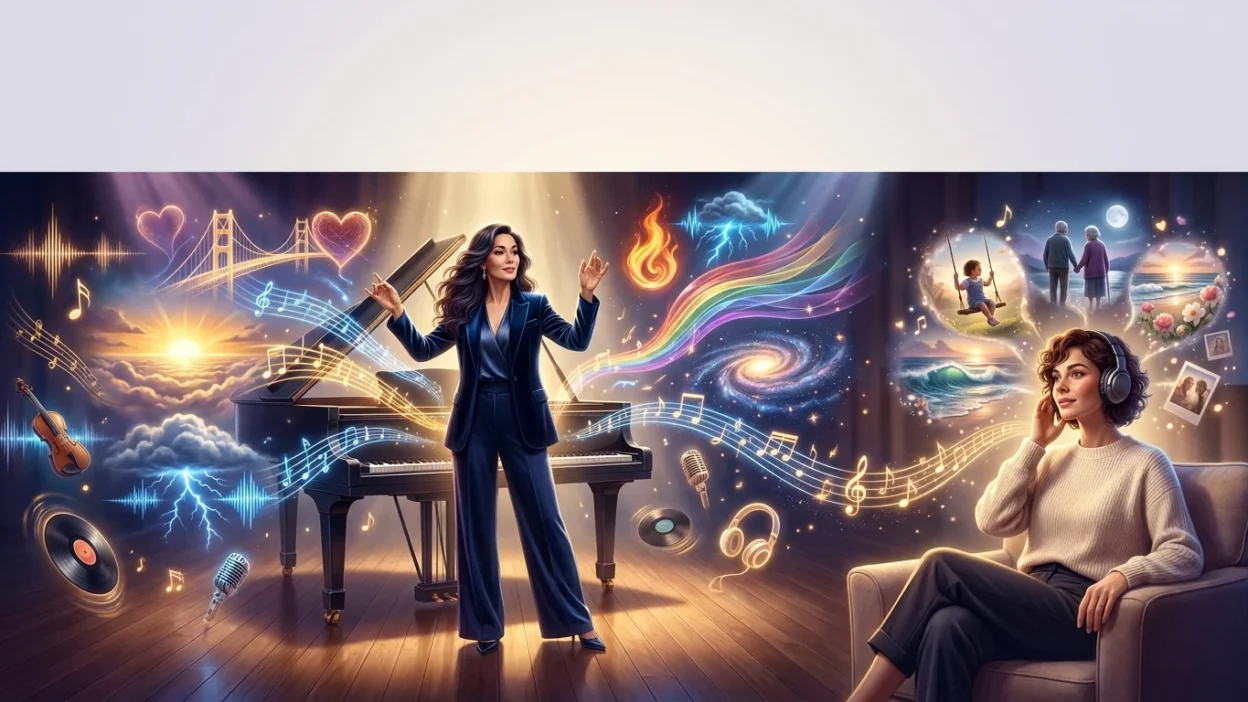
Music is more than sounds arranged together. It can carry emotions, tell stories, create memories, and connect people without using ordinary words. That is why writers often use metaphors to describe music in creative and emotional ways.
Music can be called a river, heartbeat, language, painting, journey, storm, whisper or magic. These comparisons help readers imagine what music feels like instead of simply hearing what it sounds like.
Quick Answer
Metaphors for music compare music to something else to describe its sound, emotion, rhythm, or power. Common examples include “music is a language,” “music is a river,” “music is a heartbeat,” “music is a journey” and “music is a painting.”
105 Metaphors for Music
| # | Metaphor | Meaning | Example Sentence |
|---|---|---|---|
| 1 | Music is a language. | Music communicates feelings without ordinary words. | Music is a language that speaks directly to the heart. |
| 2 | Music is a heartbeat. | Music has rhythm and emotional life. | The music was a heartbeat pulsing through the room. |
| 3 | Music is a river. | Music flows smoothly from one moment to another. | The melody was a river carrying us away. |
| 4 | Music is a journey. | Music takes listeners through different emotions. | The song was a journey through joy and sadness. |
| 5 | Music is a painting. | Music creates pictures through sound. | Her piano piece was a painting made of notes. |
| 6 | Music is a story. | Music can communicate a narrative. | The violin played a story of love and loss. |
| 7 | Music is magic. | Music creates a powerful emotional effect. | The melody was magic floating through the air. |
| 8 | Music is a bridge. | Music connects people and emotions. | Music became a bridge between two cultures. |
| 9 | Music is a key. | Music can unlock memories and feelings. | That old song was a key to forgotten memories. |
| 10 | Music is a door. | Music opens a path into another emotional world. | The song was a door into her childhood. |
| 11 | Music is a window. | Music offers a view into feelings or experiences. | His melody was a window into his soul. |
| 12 | Music is a mirror. | Music reflects emotions. | The sad song was a mirror of her heart. |
| 13 | Music is a whisper. | Music can be soft and gentle. | The piano was a whisper in the quiet room. |
| 14 | Music is a shout. | Music can express powerful emotion. | The drums were a shout of freedom. |
| 15 | Music is a storm. | Music can be intense and overwhelming. | The orchestra became a storm of sound. |
| 16 | Music is sunshine. | Music can create happiness and warmth. | Her song was sunshine on a cloudy morning. |
| 17 | Music is moonlight. | Music can feel peaceful and mysterious. | The piano sounded like moonlight on still water. |
| 18 | Music is a sunrise. | Music can represent hope and new beginnings. | The melody was a sunrise after a dark night. |
| 19 | Music is a sunset. | Music can create a peaceful, emotional ending. | The final notes were a sunset of sound. |
| 20 | Music is a flame. | Music can burn with passion. | His guitar solo was a flame of energy. |
| 21 | Music is a fire. | Music can create excitement and passion. | The band’s performance was a fire that filled the hall. |
| 22 | Music is a spark. | A song can suddenly create an emotion or idea. | The melody was a spark of inspiration. |
| 23 | Music is a candle. | Music can provide comfort in darkness. | Her favorite song was a candle during difficult nights. |
| 24 | Music is a lighthouse. | Music can guide and comfort people. | The song became a lighthouse during his darkest days. |
| 25 | Music is a compass. | Music can guide emotions and memories. | The melody was a compass pointing toward home. |
| 26 | Music is an ocean. | Music can be vast and deep. | The symphony was an ocean of sound. |
| 27 | Music is a sea. | Music can surround and immerse listeners. | We were swimming in a sea of music. |
| 28 | Music is a wave. | Music rises and falls like waves. | The chorus was a wave of emotion. |
| 29 | Music is a breeze. | Music can feel light and gentle. | The flute melody was a breeze through the trees. |
| 30 | Music is wind. | Music can move freely and invisibly. | The melody was wind moving through the room. |
| 31 | Music is a cloud. | Music can feel soft, dreamy, and floating. | The soft piano was a cloud of sound. |
| 32 | Music is a dream. | Music can transport listeners to imaginary places. | The song was a dream I did not want to leave. |
| 33 | Music is a memory. | Music can bring the past back to life. | That melody was a memory wearing a new voice. |
| 34 | Music is a photograph. | Music can preserve a moment or feeling. | The old song was a photograph of our childhood. |
| 35 | Music is a time machine. | Music can take people back to the past. | Her favorite song was a time machine to her school days. |
| 36 | Music is a diary. | Music can hold personal experiences. | His album was a diary written in melodies. |
| 37 | Music is a letter. | Music can communicate feelings to someone. | The love song was a letter to his distant partner. |
| 38 | Music is a conversation. | Musical parts can seem to speak to each other. | The piano and violin were having a conversation. |
| 39 | Music is a friend. | Music can provide comfort and companionship. | Her favorite songs were friends on lonely evenings. |
| 40 | Music is a companion. | Music can stay with us through life. | Music became his companion on every journey. |
| 41 | Music is a teacher. | Music can teach emotions, culture, and life lessons. | The song was a teacher of patience and hope. |
| 42 | Music is a healer. | Music can comfort emotional pain. | Her favorite melody was a healer for her tired heart. |
| 43 | Music is medicine. | Music can soothe and comfort people. | The piano was medicine for his troubled mind. |
| 44 | Music is a blanket. | Music can provide warmth and comfort. | The gentle melody wrapped around her like a blanket. |
| 45 | Music is a shelter. | Music can offer emotional safety. | His songs became a shelter from the noise of life. |
| 46 | Music is a home. | Music can create a feeling of belonging. | That melody felt like home. |
| 47 | Music is a safe harbor. | Music can provide peace during difficult times. | Her favorite album was a safe harbor during stressful days. |
| 48 | Music is a garden. | Music can grow many emotions and ideas. | The composition was a garden of beautiful sounds. |
| 49 | Music is a flower. | Music can bloom beautifully. | The melody was a flower opening in the silence. |
| 50 | Music is a tree. | Music can grow and develop from simple beginnings. | The song grew like a tree from a tiny idea. |
| 51 | Music is a seed. | A small musical idea can grow into something larger. | One simple note was the seed of the entire song. |
| 52 | Music is a forest. | Music can contain many layers and sounds. | The symphony was a forest of instruments. |
| 53 | Music is a garden of emotions. | Music contains many different feelings. | Her album was a garden of emotions. |
| 54 | Music is a rainbow. | Music contains many colors and moods. | The orchestra created a rainbow of sound. |
| 55 | Music is color. | Different sounds can suggest different feelings. | The trumpet painted the room with bright musical colors. |
| 56 | Music is a palette. | Music offers many tones and moods. | The composer used a palette of rich sounds. |
| 57 | Music is a brush. | Music can create emotional pictures. | Her violin became a brush painting feelings across the silence. |
| 58 | Music is ink. | Music can record thoughts and emotions. | His songs were ink flowing from his heart. |
| 59 | Music is poetry. | Music can express deep ideas beautifully. | Her lyrics were poetry carried by melody. |
| 60 | Music is a poem. | A song can tell an emotional story. | The ballad was a poem dressed in sound. |
| 61 | Music is a heartbeat of culture. | Music carries cultural identity. | Traditional music is the heartbeat of the community. |
| 62 | Music is the soul of a culture. | Music expresses cultural identity. | Folk music is the soul of the region. |
| 63 | Music is the voice of history. | Music preserves historical experiences. | The old song was the voice of history. |
| 64 | Music is the voice of the heart. | Music expresses emotions. | Her piano was the voice of her heart. |
| 65 | Music is the soul speaking. | Music communicates deep inner feelings. | His guitar sounded like the soul speaking. |
| 66 | Music is a heartbeat of humanity. | Music connects people across time and place. | Music is a heartbeat of humanity that never stops. |
| 67 | Music is a universal language. | People across cultures can connect through it. | Music is a universal language that crosses borders. |
| 68 | Music is a thread. | Music connects moments or people. | The melody was a golden thread connecting generations. |
| 69 | Music is a golden thread. | Music connects people through shared feelings. | The song became a golden thread between mother and daughter. |
| 70 | Music is a chain. | Music can connect one emotion to another. | Each note formed another link in the chain of the melody. |
| 71 | Music is a road. | Music can lead listeners through emotions. | The song was a road through memories. |
| 72 | Music is a highway. | Music can move rapidly through different moods. | The energetic track was a highway of rhythm. |
| 73 | Music is a staircase. | Music can build gradually toward a climax. | The rising notes formed a staircase of excitement. |
| 74 | Music is a ladder. | Music can lift emotions higher. | The melody was a ladder carrying her toward happiness. |
| 75 | Music is a rocket. | Music can create sudden excitement. | The chorus was a rocket of energy. |
| 76 | Music is fuel. | Music can provide emotional energy. | His favorite playlist was fuel for his creativity. |
| 77 | Music is electricity. | Music can create powerful energy. | The concert was electricity flowing through the crowd. |
| 78 | Music is an engine. | Music can drive action and emotion. | The drumbeat was an engine pushing the dancers forward. |
| 79 | Music is a motor. | Rhythm can keep movement going. | The bass became the motor of the dance. |
| 80 | Music is a heartbeat in the room. | Music creates shared energy. | The drums became a heartbeat in the room. |
| 81 | Music is a pulse. | Music has rhythm and repeated energy. | The bass gave the song a powerful pulse. |
| 82 | Music is a drumbeat of life. | Music reflects life’s energy and movement. | The rhythm was a drumbeat of life. |
| 83 | Music is a clock. | Rhythm can organize time and movement. | The steady beat was a clock guiding the dancers. |
| 84 | Music is a magnet. | Music can strongly attract attention. | The singer’s voice was a magnet for the crowd. |
| 85 | Music is gravity. | Music can pull people emotionally toward it. | The haunting melody had the gravity of a powerful memory. |
| 86 | Music is a spell. | Music can capture and hold attention. | The violin placed the audience under a spell. |
| 87 | Music is an enchantment. | Music can create wonder and fascination. | Her voice was an enchantment floating through the theater. |
| 88 | Music is a spell on the heart. | Music can deeply affect emotions. | The ballad was a spell on the heart. |
| 89 | Music is a dreamscape. | Music can create an imaginary world. | The ambient track opened a dreamscape in my mind. |
| 90 | Music is a universe. | Music contains endless possibilities. | The composer created a universe of sound. |
| 91 | Music is a galaxy. | Different notes and instruments form a vast whole. | The symphony was a galaxy of melodies. |
| 92 | Music is a constellation. | Individual notes combine into something beautiful. | Every note was a star in the constellation of the song. |
| 93 | Music is a star. | A song can shine and stand out. | Her new single was a star in the world of music. |
| 94 | Music is a moon. | Music can create a calm, mysterious presence. | The soft melody was a moon in the darkness. |
| 95 | Music is a firework. | Music can explode with excitement. | The final chorus was a firework of sound. |
| 96 | Music is a celebration. | Music can express joy and togetherness. | The drums turned the festival into a celebration of life. |
| 97 | Music is a dance. | Music moves with rhythm and emotion. | The melody was a dance between piano and violin. |
| 98 | Music is a heartbeat between souls. | Music creates emotional connection. | Their shared song was a heartbeat between souls. |
| 99 | Music is a bridge between hearts. | Music connects people emotionally. | The song became a bridge between their hearts. |
| 100 | Music is a bridge between generations. | Music can connect different age groups. | The old melody was a bridge between generations. |
| 101 | Music is a doorway to emotion. | Music helps people experience feelings. | The piano was a doorway to emotions she could not explain. |
| 102 | Music is a river of memories. | Music can bring back many past experiences. | The song opened a river of memories. |
| 103 | Music is a storm of emotions. | Music can create many strong feelings at once. | The orchestra became a storm of emotions. |
| 104 | Music is a garden where feelings bloom. | Music allows emotions to grow and appear. | Her album was a garden where feelings bloomed. |
| 105 | Music is a heartbeat that never stops. | Music represents the lasting power of sound and emotion. | For him, music was a heartbeat that never stopped. |
How to Use Metaphors for Music
Music metaphors are useful when you want to describe how music sounds, feels, moves or affects people.
Instead of:
The music was beautiful.
You can write:
The music was moonlight floating across the room.
Instead of:
The song made everyone happy.
You can write:
The song was sunshine pouring into every heart.
Instead of:
The music reminded her of childhood.
You can write:
The melody was a time machine carrying her back to childhood.
These metaphors work especially well in creative writing, poetry, essays, song reviews, stories, speeches and descriptive paragraphs.
Common Mistakes When Using Metaphors for Music
1. Mixing too many metaphors
Avoid putting several unrelated comparisons into one sentence.
Weak:
“The song was a river, rocket, flower, mountain and storm of sunshine.”
Better:
“The song was a river carrying us through a sea of memories.”
2. Using metaphors that do not match the mood
A peaceful song might be better described as moonlight, a breeze, a whisper or a gentle river.
An energetic song might be better described as fire, electricity, a storm or a rocket.
3. Making every music metaphor about happiness
Music can represent sadness, anger, love, loneliness, hope, excitement, peace and nostalgia too.
4. Making the comparison unclear
Make sure the reader can understand why you chose the metaphor.
Clear:
“Her voice was a lighthouse, guiding me through a difficult night.”
5. Overusing common comparisons
Words such as “music is a language” are useful, but adding fresh images such as “music is a river of memories” can make your writing more original.
Similar Expressions for Music
Here are some expressions related to music metaphors:
- The language of music
- The voice of the heart
- A song of hope
- A melody of love
- A symphony of emotions
- A rhythm of life
- A river of sound
- A wave of emotion
- A chorus of voices
- A dance of notes
- A song of freedom
- A heartbeat of culture
- A harmony of hearts
- A storm of sound
- A whisper of melody
- A sea of music
- A world of sound
- A melody of memories
- A song of the soul
- The soundtrack of life
10 Practice Questions About Metaphors for Music
1. Which metaphor describes music as a way of communicating feelings?
A. Music is a language.
B. Music is a mountain.
C. Music is a door.
Answer: A. Music is a language.
2. Complete the sentence:
“Music is a ______ carrying us through memories.”
Answer: river
3. What does “music is a heartbeat” mean?
Answer: It suggests that music has rhythm, energy, and emotional life.
4. Which metaphor suggests that music can bring back the past?
A. Music is a rocket.
B. Music is a time machine.
C. Music is a staircase.
Answer: B. Music is a time machine.
5. Complete the sentence:
“Her song was ______ on a cloudy morning.”
Answer: sunshine
6. What does “music is a bridge” suggest?
Answer: It suggests that music can connect people, cultures, emotions, or generations.
7. Which metaphor best describes intense music?
A. Music is a whisper.
B. Music is a storm.
C. Music is a blanket.
Answer: B. Music is a storm.
8. Write a sentence using “music is a mirror.”
Answer: “Her music was a mirror reflecting the sadness hidden in her heart.”
9. Which metaphor describes music as something comforting?
A. Music is a shelter.
B. Music is a rocket.
C. Music is a sword.
Answer: A. Music is a shelter.
10. Complete the sentence:
“Every note was a ______ in the constellation of the song.”
Answer: star
FAQs About Metaphors for Music
What is a metaphor for music?
A metaphor for music compares music to another thing to describe its sound, feeling, movement, or emotional effect. For example, “Music is a river” suggests that music flows smoothly.
What is a powerful metaphor for music?
“Music is the language of the heart” is a powerful metaphor because it shows how music can communicate emotions without ordinary words.
What is a metaphor for beautiful music?
You can describe beautiful music as “moonlight,” “sunshine,” “a garden,” “a painting,” “a rainbow,” or “a river.”
What is a metaphor for sad music?
Sad music can be described as “a rainy window,” “a river of memories,” “a whisper in the darkness,” or “a mirror of the heart.”
What is a metaphor for loud music?
Loud music can be described as “a storm,” “a thunderclap,” “a wave,” “an explosion,” or “a roar.”
What is a metaphor for music and emotions?
“Music is a mirror” is an excellent metaphor because it suggests that music reflects the emotions inside us.
What does music symbolize in literature?
Music can symbolize love, freedom, memory, identity, sadness, joy, connection, hope, creativity, and the human spirit.
Can I use music metaphors in essays?
Yes. Music metaphors can make essays more vivid, especially when discussing art, emotions, culture, creativity, memories or personal experiences.
Can I use these metaphors in poetry?
Yes. Music metaphors are especially effective in poetry because they create strong sensory and emotional images.
Why do writers use metaphors for music?
Writers use metaphors because sound can be difficult to explain directly. Comparing music to water, light, fire, color, nature or journeys gives readers something they can imagine and feel.
Conclusion
Music is one of the easiest subjects to describe through metaphor because it can feel like almost anything. It can be a river that carries us away, a heartbeat that keeps us alive, a bridge that connects hearts, a fire that creates passion, a mirror that reflects emotions or a time machine that returns us to the past.
Whether you are writing a poem, essay, story, song review, or personal reflection, a strong music metaphor can turn a simple description into something memorable. Let your words move like music, flow like a river and speak like the heart.

Logan Liam is the administrator of SmiliesHive, managing educational content about idioms, metaphors, and similes while ensuring clear, accurate, engaging, and beginner-friendly language resources for readers worldwide.