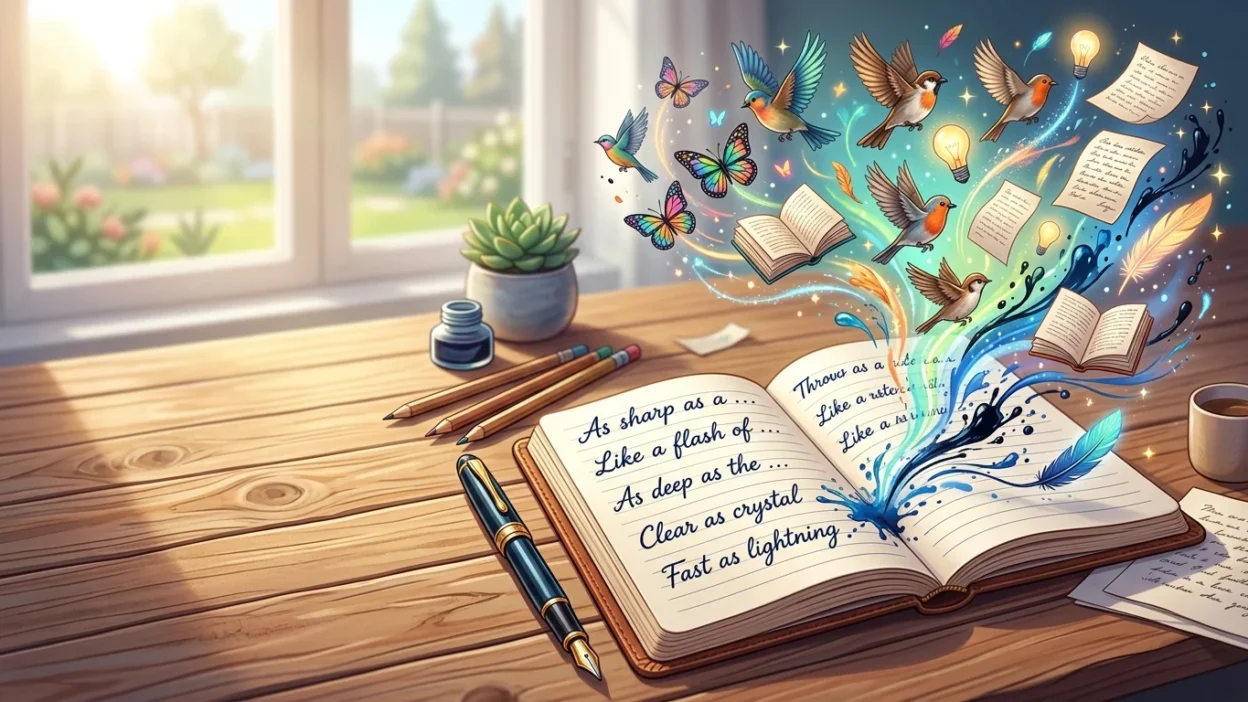
Writing is a wonderful way to share ideas, tell stories and express emotions. However, repeating the same words can make your work less interesting. That’s where similes for writing come in. Similes compare writing to something else using like or as, helping readers picture the writing style, speed, beauty or purpose more clearly.
Whether you’re a student, teacher, blogger or creative writer, learning similes for writing can improve your vocabulary and make your descriptions more vivid. In this article, you’ll discover 30 original similes for writing, along with their meanings and examples. You’ll also find common mistakes, similar expressions, practice questions, FAQs and a helpful conclusion.
Quick Answer
Similes for writing compare the act or style of writing to another object or action using like or as. They make descriptions more colorful and help readers better understand how someone writes or how writing feels.
30 Similes for Writing
| Simile | Meaning | Example |
|---|---|---|
| As smooth as flowing ink | Easy and natural writing | Her essay was as smooth as flowing ink. |
| Like a river finding its way | Ideas flow naturally | His words moved like a river finding its way. |
| As clear as a polished mirror | Easy to understand | The article was as clear as a polished mirror. |
| Like birds singing at sunrise | Beautiful and expressive | Her poems sounded like birds singing at sunrise. |
| As fast as lightning on paper | Writing very quickly | He finished the report as fast as lightning on paper. |
| Like a painter with bright colors | Creative writing | She wrote like a painter with bright colors. |
| As gentle as falling snow | Calm and soft writing | The letter was as gentle as falling snow. |
| Like music filling a room | Pleasant to read | His story flowed like music filling a room. |
| As sharp as a freshly sharpened pencil | Precise writing | Her arguments were as sharp as a freshly sharpened pencil. |
| Like rain watering a garden | Inspiring words | His speech spread like rain watering a garden. |
| Simile | Meaning | Example |
|---|---|---|
| As colorful as a rainbow | Rich in imagination | The story was as colorful as a rainbow. |
| Like stars lighting the night | Inspiring readers | Her words shined like stars lighting the night. |
| As neat as printed pages | Well-organized writing | His notes were as neat as printed pages. |
| Like waves rolling to shore | Smooth flow of ideas | The paragraphs moved like waves rolling to shore. |
| As bright as the morning sun | Positive writing | The article felt as bright as the morning sun. |
| Like a bee gathering nectar | Carefully collecting ideas | She researched like a bee gathering nectar. |
| As steady as a ticking clock | Consistent writing | His daily journal was as steady as a ticking clock. |
| Like vines climbing a wall | Ideas growing naturally | The story developed like vines climbing a wall. |
| As light as a feather | Easy to read | The children’s book was as light as a feather. |
| Like footprints in the sand | Leaving a lasting impression | His novel stayed with readers like footprints in the sand. |
| Simile | Meaning | Example |
|---|---|---|
| As fresh as spring rain | Original writing | Her blog posts were as fresh as spring rain. |
| Like a candle lighting the dark | Informative writing | The guide helped readers like a candle lighting the dark. |
| As rich as a treasure chest | Full of ideas | The essay was as rich as a treasure chest. |
| Like an artist creating a masterpiece | Careful writing | He edited every sentence like an artist creating a masterpiece. |
| As lively as a festival | Energetic writing | The dialogue was as lively as a festival. |
| Like a butterfly dancing in the wind | Graceful writing | Her poetry floated like a butterfly dancing in the wind. |
| As strong as an ancient oak | Powerful writing | The conclusion was as strong as an ancient oak. |
| Like sunshine after rain | Uplifting words | Her message felt like sunshine after rain. |
| As timeless as the stars | Writing that lasts | The novel became as timeless as the stars. |
| Like seeds growing into trees | Ideas developing over time | Great writing grows like seeds growing into trees. |
Common Mistakes
- Using too many similes in one paragraph.
- Mixing similes with metaphors.
- Choosing comparisons that don’t fit the context.
- Repeating the same simile throughout the article.
- Forgetting to use like or as.
- Using complicated similes that confuse readers.
Similar Expressions
- Put pen to paper
- Express your thoughts
- Paint a picture with words
- Tell a story
- Write with clarity
- Creative expression
- Flow of ideas
- Powerful storytelling
- Descriptive writing
- Wordcraft
Practice Questions
1. What is a simile?
Answer: A comparison using like or as.
2. Complete the simile: As smooth as ________.
Answer: Flowing ink.
3. Which simile describes creative writing?
Answer: Like a painter with bright colors.
4. Is “Writing is magic” a simile?
Answer: No. It is a metaphor.
5. Write a sentence using “like music filling a room.”
Answer: Her novel flowed like music filling a room.
6. Why do writers use similes?
Answer: To make writing more vivid and engaging.
7. Which words usually introduce a simile?
Answer: Like and as.
8. Name one similar expression for writing.
Answer: Paint a picture with words.
9. True or False: Similes improve descriptive writing.
Answer: True.
10. Can you create your own similes?
Answer: Yes. Original similes make writing unique.
FAQs
What are similes for writing?
They are comparisons that describe writing using like or as to make it more expressive.
Why should I use similes in my writing?
They make your work more descriptive, engaging, and memorable.
Are similes part of figurative language?
Yes. Similes are one of the most common literary devices.
Can students use similes in essays?
Yes. They improve descriptive and creative writing.
What’s the difference between a simile and a metaphor?
A simile uses like or as, while a metaphor compares two things directly.
Can I create original similes?
Absolutely! Original similes make your writing more creative and personal.
Conclusion
Using similes for writing is an excellent way to make your words more vivid, engaging and memorable. Instead of describing writing in ordinary ways, creative comparisons help readers imagine ideas, emotions and styles more clearly. Whether you’re writing stories, essays, blogs or poems, these similes can improve your expression and make your work stand out. Practice using them naturally, experiment with your own comparisons and enjoy becoming a more confident and creative writer.