
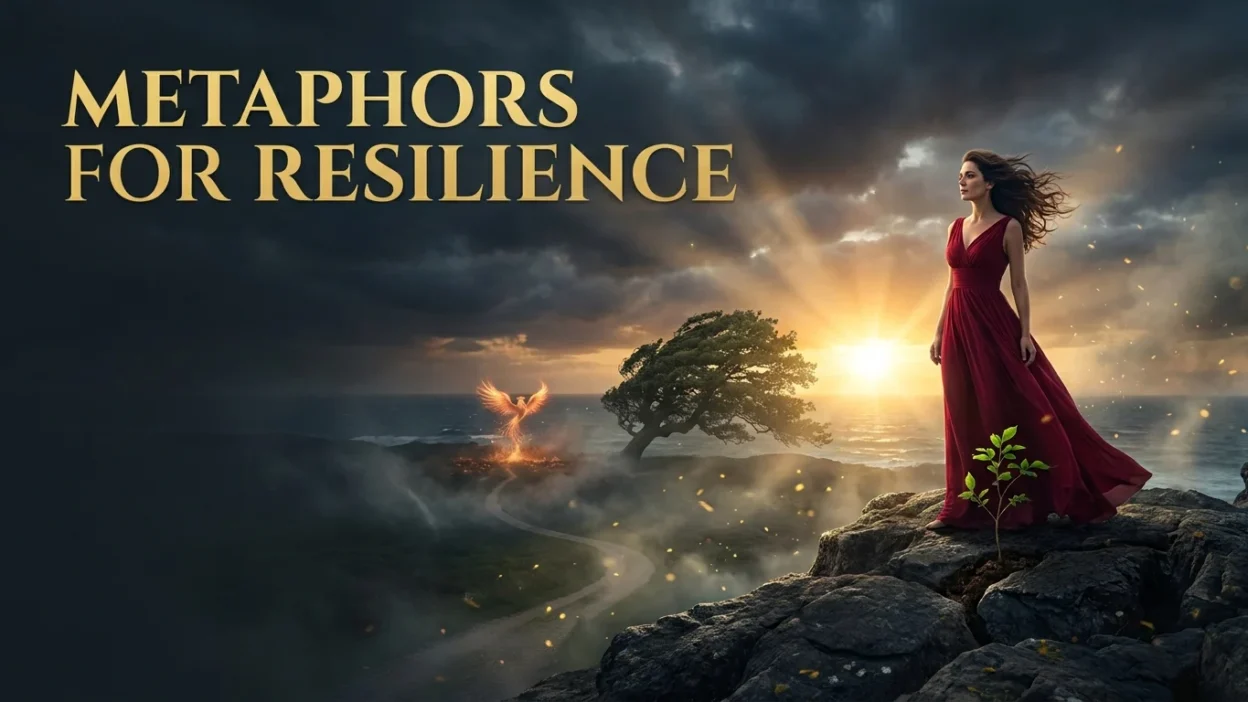
Resilience is the strength to face hard times, recover from setbacks and keep moving forward when life becomes difficult. Everyone faces challenges, such as failure, disappointment, loss or unexpected change. What matters is how we respond to those challenges and find the courage to begin again. Sometimes, ordinary words cannot fully express this inner strength. That is where metaphors can help.
Metaphors for resilience describe strength, hope, recovery and determination through vivid images. For example “Resilience is a tree that bends in the storm” shows how a person can adapt to difficult situations without giving up. Similarly “Resilience is a phoenix rising from the ashes” represents the ability to rebuild life after a painful experience.
These expressions are useful in creative writing, poetry, speeches, personal essays and everyday conversations. They help readers picture difficult emotions and understand the power of perseverance. In this article you will discover 100 original style metaphors for resilience, along with their meanings, explanations and example sentences. You will also learn how to use these literary devices naturally in your writing.
Quick Answer: What Are Metaphors for Resilience?
Metaphors for resilience describe the ability to recover from difficulties by comparing it to something strong, flexible, or enduring. For example “Resilience is a deep rooted tree” suggests that strong inner values help someone survive life’s storms. These metaphors express courage, adaptability, hope and the determination to begin again after setbacks.
What Is a Metaphor for Resilience?
A metaphor is a figure of speech that describes one thing as another to show a shared quality. It does not use “like” or “as” to make a direct comparison.
A metaphor for resilience describes how people handle hardship, recover from setbacks, and continue growing.
For example:
- Resilience is a rubber band. It stretches under pressure and returns to shape.
- Resilience is an iron shield. It represents strength when facing difficulties.
- Resilience is a sunrise after a storm. It symbolizes hope and a fresh beginning after a difficult period.
These expressions turn an abstract quality into something readers can imagine. Writers use them to make stories, poems, essays, and motivational messages more powerful.
100 Powerful Metaphors for Resilience With Meanings and Examples
The following metaphors explore perseverance, emotional strength, recovery, adaptability, courage, and personal growth.
1. Metaphors for Inner Strength and Endurance
These metaphors describe the inner power that helps people withstand difficult situations.
| # | Metaphor | Meaning and Explanation | Example Sentences |
|---|---|---|---|
| 1 | Resilience is an iron shield. | Inner strength helps protect you during difficult times. | 1. Her resilience was an iron shield against criticism. 2. He carried an iron shield of courage into every challenge. |
| 2 | Resilience is a mountain with deep roots. | A resilient person remains steady under pressure. | 1. His resilience was a mountain that refused to fall. 2. She stood like a mountain in the face of hardship. |
| 3 | Resilience is an oak tree in a storm. | Strength and stability help someone survive trouble. | 1. Her spirit was an oak tree during the crisis. 2. He remained an oak tree while problems shook his world. |
| 4 | Resilience is a steel backbone. | Inner determination helps someone stand firm. | 1. She showed a steel backbone after her failure. 2. His resilience gave him the backbone to start again. |
| 5 | Resilience is a fortress of courage. | Courage creates a strong defense against fear. | 1. His mind became a fortress of courage. 2. She built a fortress of courage through experience. |
| 6 | Resilience is a diamond under pressure. | Difficult experiences can reveal strength and value. | 1. Her resilience was a diamond under pressure. 2. The difficult years revealed the diamond within him. |
| 7 | Resilience is a deep-rooted tree. | Strong values help a person remain grounded. | 1. His resilience was a tree with roots deep in hope. 2. She stayed grounded like a tree rooted in firm soil. |
| 8 | Resilience is a stone wall against despair. | Inner strength helps resist hopelessness. | 1. Her determination was a stone wall against despair. 2. He built a wall of hope around his dreams. |
| 9 | Resilience is an unbroken pillar. | A person remains dependable through hardship. | 1. She was an unbroken pillar for her family. 2. His resilience became a pillar supporting everyone around him. |
| 10 | Resilience is a fireproof heart. | Emotional strength helps someone endure painful experiences. | 1. She carried a fireproof heart through her struggles. 2. His fireproof heart kept hope alive during difficult days. |
| 11 | Resilience is a fortress on a hill. | Strength provides a steady place during uncertainty. | 1. Her mind was a fortress on a hill above fear. 2. He built his fortress with patience and courage. |
| 12 | Resilience is a rope made of steel. | Determination holds firm when life pulls hard. | 1. Her resilience was a steel rope holding her dreams together. 2. He gripped the rope of courage when trouble arrived. |
| 13 | Resilience is an anchor in rough waters. | Inner stability keeps a person from being overwhelmed. | 1. Hope was an anchor in his rough waters. 2. Her resilience anchored the family during uncertainty. |
| 14 | Resilience is a flame behind glass. | Strength continues burning even when surrounded by difficulty. | 1. Her spirit was a flame behind glass. 2. The pressure could not put out his inner flame. |
| 15 | Resilience is a sturdy bridge. | Strength connects hardship with a way forward. | 1. Her courage became a sturdy bridge across despair. 2. Resilience built a bridge from failure to progress. |
| 16 | Resilience is a shield woven from experience. | Lessons from past challenges help protect us in the future. | 1. His resilience was a shield woven from experience. 2. Each mistake added another thread to her shield. |
| 17 | Resilience is a lighthouse on a cliff. | Strength and hope provide direction during uncertainty. | 1. Her determination was a lighthouse on a dangerous coast. 2. His resilience kept shining through the fog of doubt. |
| 18 | Resilience is a locked treasure chest of courage. | Inner strength may remain hidden until it is needed. | 1. She discovered a treasure chest of courage within herself. 2. Hard times unlocked the courage he never knew he possessed. |
| 19 | Resilience is a mountain spring. | Strength can keep flowing even in difficult conditions. | 1. Her resilience was a spring rising from rocky ground. 2. Hope flowed through him like water from a hidden spring. |
| 20 | Resilience is a strong heartbeat. | The will to continue remains alive through hardship. | 1. His resilience was a strong heartbeat beneath his fear. 2. She followed the steady heartbeat of her determination. |
2. Metaphors for Bouncing Back After Failure
These expressions focus on recovery, rebuilding, and finding a new beginning.
| # | Metaphor | Meaning and Explanation | Example Sentences |
|---|---|---|---|
| 21 | Resilience is a phoenix rising from ashes. | A person rebuilds life after loss or failure. | 1. Her new business was a phoenix rising from ashes. 2. He became a phoenix after his painful defeat. |
| 22 | Resilience is a sunrise after a long night. | Hope returns after a difficult period. | 1. Her graduation was a sunrise after years of struggle. 2. The new opportunity felt like sunrise after a long night. |
| 23 | Resilience is a second wind. | Renewed energy helps someone continue after exhaustion. | 1. His determination gave him a second wind. 2. She found a second wind after weeks of disappointment. |
| 24 | Resilience is a fresh page. | Recovery offers an opportunity to begin again. | 1. The new job was a fresh page in his life. 2. She treated every setback as a fresh page. |
| 25 | Resilience is a repaired sail. | A person adjusts and continues after being damaged by hardship. | 1. Her confidence was a repaired sail ready for new winds. 2. He mended his hopes and raised his sail again. |
| 26 | Resilience is a bridge rebuilt after a flood. | A person restores stability after a major setback. | 1. Their trust was a bridge rebuilt after the flood of lies. 2. She rebuilt her confidence like a bridge after disaster. |
| 27 | Resilience is a seed breaking through concrete. | Determination finds a way despite serious obstacles. | 1. His dream was a seed breaking through concrete. 2. Her ambition pushed upward through the hard ground of rejection. |
| 28 | Resilience is a new chapter after a plot twist. | An unexpected problem can lead to a new direction. | 1. Losing the competition became a new chapter for him. 2. She turned her setback into a surprising new chapter. |
| 29 | Resilience is a patched sailboat. | Even after damage, a person can continue the journey. | 1. Her life was a patched sailboat still crossing the sea. 2. He repaired his plans and returned to the water. |
| 30 | Resilience is a broken clock ticking again. | Something that seemed finished can regain its function or purpose. | 1. Her confidence was a broken clock ticking again. 2. He began moving forward like a clock brought back to life. |
| 31 | Resilience is a garden after winter. | New growth follows a difficult season. | 1. Her life became a garden after winter. 2. Hope planted fresh flowers in his frozen world. |
| 32 | Resilience is a candle relit. | Hope can return after it has nearly disappeared. | 1. Her courage was a candle relit in darkness. 2. One kind word relit the candle of his hope. |
| 33 | Resilience is a fallen tower rebuilt. | Recovery involves rebuilding what has been lost. | 1. His career was a fallen tower rebuilt with patience. 2. She rebuilt her plans stone by stone. |
| 34 | Resilience is a road beyond a landslide. | A new path can appear after a major obstacle. | 1. Her resilience found a road beyond the landslide. 2. He created a new route when his old plans collapsed. |
| 35 | Resilience is a repaired wing. | Healing helps someone regain the ability to move forward. | 1. Her confidence was a repaired wing ready for flight. 2. He healed his disappointment and spread his wings again. |
| 36 | Resilience is a door opening after a wall falls. | A setback can reveal new possibilities. | 1. His failure became a door to a better career. 2. She found an open door where she once saw a wall. |
| 37 | Resilience is a river finding a new course. | Adaptability helps someone continue after change. | 1. Her life was a river finding a new course. 2. He changed direction when his old path disappeared. |
| 38 | Resilience is a song after silence. | A person finds their voice and hope again. | 1. Her first performance was a song after silence. 2. He filled his quiet world with the music of new beginnings. |
| 39 | Resilience is a repaired mosaic. | Broken experiences can become part of a meaningful whole. | 1. Her life became a repaired mosaic of lessons and hope. 2. He turned painful memories into pieces of a stronger story. |
| 40 | Resilience is a boat returning to shore. | A person finds safety and stability after a difficult journey. | 1. Rest was the shore where her tired spirit returned. 2. After months of struggle, he guided his life back to shore. |
3. Metaphors for Adaptability and Flexibility
Resilience is not only about standing firm. It also means adjusting when circumstances change.
| # | Metaphor | Meaning and Explanation | Example Sentences |
|---|---|---|---|
| 41 | Resilience is bamboo in the wind. | Flexibility helps a person withstand pressure. | 1. Her spirit was bamboo bending in the wind. 2. He adapted to change like bamboo in a storm. |
| 42 | Resilience is a rubber band. | A person can stretch under pressure and recover. | 1. Her resilience was a rubber band pulled by life’s demands. 2. He stretched through the challenge and found his balance again. |
| 43 | Resilience is water around a rock. | Adaptability helps someone find a way around obstacles. | 1. Her determination was water moving around a rock. 2. He found another route instead of fighting the same barrier. |
| 44 | Resilience is a willow that bends. | Flexibility helps someone survive strong pressure. | 1. She was a willow bending but not breaking. 2. His flexible thinking helped him survive the crisis. |
| 45 | Resilience is a chameleon changing colors. | Adaptability helps someone respond to changing conditions. | 1. Her resilience was a chameleon adjusting to a new world. 2. He changed his approach when the situation changed. |
| 46 | Resilience is a sail catching new winds. | A person uses changing conditions to move forward. | 1. She turned disappointment into a sail catching new winds. 2. He adjusted his plans and sailed toward a new goal. |
| 47 | Resilience is a river around fallen trees. | Progress continues by finding another path. | 1. Her spirit was a river flowing around fallen trees. 2. He found a solution when the original route was blocked. |
| 48 | Resilience is clay in skilled hands. | A person can adapt and reshape their life. | 1. Her future was clay shaped by patient hands. 2. He reshaped his plans when life changed direction. |
| 49 | Resilience is a tree growing toward the light. | Growth continues despite obstacles. | 1. Her ambition was a tree reaching toward the light. 2. He kept learning even when progress felt slow. |
| 50 | Resilience is a compass that resets. | A person can find direction again after confusion. | 1. Her resilience was a compass pointing toward new hope. 2. He reset his direction after his plans failed. |
| 51 | Resilience is a kite using strong winds. | Challenges can sometimes become opportunities. | 1. She used criticism as a kite uses the wind. 2. His determination lifted him higher when challenges increased. |
| 52 | Resilience is a flexible branch. | Being flexible reduces the chance of breaking under pressure. | 1. Her mind was a flexible branch in a storm. 2. He changed his strategy rather than giving up. |
| 53 | Resilience is a bridge that adjusts to the tide. | Adaptability keeps a person steady through changing conditions. | 1. Their plan was a bridge adjusting to the tide. 2. She changed her schedule without losing her goal. |
| 54 | Resilience is a migratory bird. | Moving forward may require changing direction or surroundings. | 1. His spirit was a migratory bird seeking a better season. 2. She moved toward opportunities when her old environment no longer helped her grow. |
| 55 | Resilience is a woven net. | Many skills and support systems help a person adapt. | 1. Her resilience was a net woven from courage and experience. 2. He relied on a network of skills when plans changed. |
| 56 | Resilience is a key that fits a new lock. | New problems may require new solutions. | 1. Her creativity was a key for an unfamiliar lock. 2. He searched for a different key when the old one failed. |
| 57 | Resilience is a mountain path around a cliff. | Adaptability finds a safer way forward. | 1. She found a mountain path around the obstacle. 2. His flexible thinking opened a route around failure. |
| 58 | Resilience is a new branch after pruning. | Change can create room for fresh growth. | 1. Her career grew a new branch after a difficult ending. 2. He discovered new interests after leaving his old path. |
| 59 | Resilience is a sailboat adjusting its sails. | A person changes their approach without abandoning the destination. | 1. She adjusted her sails when the market changed. 2. He altered his strategy but kept his dream alive. |
| 60 | Resilience is a path through shifting sand. | Progress requires continuous adjustment. | 1. Her recovery was a path through shifting sand. 2. He took small steps and adjusted as the ground changed. |
4. Metaphors for Hope and Perseverance
These metaphors show how hope and persistence help people continue during uncertainty.
| # | Metaphor | Meaning and Explanation | Example Sentences |
|---|---|---|---|
| 61 | Resilience is a candle in the dark. | Even a small amount of hope can guide someone forward. | 1. Her hope was a candle in the dark. 2. One encouraging message became a candle in his darkest hour. |
| 62 | Resilience is a star through clouds. | Hope remains present even when it is difficult to see. | 1. His dream was a star behind heavy clouds. 2. She followed the small star of hope through uncertainty. |
| 63 | Resilience is a sunrise on the horizon. | Better days may follow difficult experiences. | 1. Her new opportunity was a sunrise on the horizon. 2. He kept walking toward the sunrise of a better future. |
| 64 | Resilience is a lamp on a dark road. | Hope offers guidance when the future is unclear. | 1. Her courage was a lamp on a dark road. 2. His purpose lit the road through disappointment. |
| 65 | Resilience is a seed of hope. | A small belief can grow into a stronger future. | 1. One kind word planted a seed of hope in her heart. 2. His resilience was a seed growing through hard ground. |
| 66 | Resilience is a bell that keeps ringing. | Determination continues to call someone forward. | 1. Her ambition was a bell ringing through the silence. 2. He followed the steady bell of his purpose. |
| 67 | Resilience is a flame that refuses to die. | Hope continues even during repeated setbacks. | 1. Her courage was a flame that refused to die. 2. Failure could not extinguish the flame of his dream. |
| 68 | Resilience is a lighthouse beam through fog. | Hope helps a person find direction in confusion. | 1. Her faith in herself was a lighthouse beam through fog. 2. His goal became a beam guiding him out of uncertainty. |
| 69 | Resilience is a golden thread through darkness. | A small source of hope connects someone to a better future. | 1. Kindness was a golden thread through her darkest days. 2. He held the thread of hope when everything felt uncertain. |
| 70 | Resilience is a drumbeat of determination. | Steady effort continues despite difficulty. | 1. Her determination was a drumbeat beneath the noise of doubt. 2. He followed the rhythm of persistence every morning. |
| 71 | Resilience is a river that never stops. | Persistence keeps progress moving. | 1. Her spirit was a river that never stopped flowing. 2. He continued learning like a river moving toward the sea. |
| 72 | Resilience is a mountain trail marked with stars. | Hope can guide someone through a difficult journey. | 1. Her dreams were stars along a mountain trail. 2. He followed each small sign of progress toward his goal. |
| 73 | Resilience is a bridge to tomorrow. | Courage helps someone move toward a better future. | 1. Every small step was a bridge to tomorrow. 2. She crossed the bridge of uncertainty with hope. |
| 74 | Resilience is a clock that keeps ticking. | Life continues, and steady action remains possible. | 1. Her courage was a clock that kept ticking after loss. 2. He used each new day as another chance to move forward. |
| 75 | Resilience is a pocket of sunlight. | Even in hardship, small moments of happiness can remain. | 1. Her friendship was a pocket of sunlight in a difficult year. 2. He carried little moments of joy through the darkest days. |
| 76 | Resilience is a garden of tomorrow. | Today’s effort can create future growth. | 1. Her hard work planted a garden of tomorrow. 2. He cared for his goals even when results were far away. |
| 77 | Resilience is a map drawn by hope. | Hope helps a person imagine a path forward. | 1. Her hope was a map through uncertainty. 2. He drew a new map after his original plans failed. |
| 78 | Resilience is a promise to the future. | A person keeps making efforts for better days. | 1. Her education was a promise to the future. 2. He treated every new morning as a promise of possibility. |
| 79 | Resilience is a bell over a sleeping town. | Hope can awaken courage when people feel discouraged. | 1. Her speech was a bell over a sleeping town. 2. His example awakened hope in the team. |
| 80 | Resilience is a horizon that keeps opening. | New possibilities appear as someone continues forward. | 1. Her life was a horizon opening beyond every setback. 2. He kept moving until new opportunities came into view. |
5. Metaphors for Growth, Healing and Transformation
These metaphors describe how difficult experiences can lead to learning, healing, and change.
| # | Metaphor | Meaning and Explanation | Example Sentences |
|---|---|---|---|
| 81 | Resilience is a wound becoming a scar. | Healing allows painful experiences to become part of the past. | 1. Her resilience was a wound becoming a scar. 2. His painful experience became a scar that reminded him of his strength. |
| 82 | Resilience is a butterfly leaving its cocoon. | A person transforms through a period of difficulty. | 1. Her new confidence was a butterfly leaving its cocoon. 2. He emerged from hardship with new wings. |
| 83 | Resilience is iron forged in fire. | Pressure and challenges can build strength. | 1. His character was iron forged in fire. 2. The difficult years forged her determination. |
| 84 | Resilience is a forest growing after a fire. | Life and growth can return after destruction. | 1. Their community was a forest growing after a fire. 2. New friendships filled the space left by old disappointments. |
| 85 | Resilience is a flower through a crack. | Growth can happen in unlikely conditions. | 1. Her ambition was a flower through a crack in the pavement. 2. His creativity blossomed where others saw no opportunity. |
| 86 | Resilience is a pot repaired with gold. | Healing can create a meaningful new strength. | 1. Her story was a pot repaired with gold. 2. He turned his broken plans into something valuable and new. |
| 87 | Resilience is a caterpillar becoming a butterfly. | Change can lead to a stronger or more capable self. | 1. Her recovery was a caterpillar becoming a butterfly. 2. He grew beyond his old fears and spread his wings. |
| 88 | Resilience is a tree growing new rings. | Each year of experience adds strength and history. | 1. Her resilience was a tree adding new rings. 2. Every challenge became another ring in his story. |
| 89 | Resilience is a river polishing stones. | Time and experience can shape a person’s character. | 1. Life polished his patience like a river polishing stones. 2. Her difficult journey shaped her into a wiser person. |
| 90 | Resilience is a sunrise painting a ruined sky. | Hope can bring beauty and possibility after hardship. | 1. Her recovery was a sunrise painting the ruined sky. 2. He found beauty in the new life he built after loss. |
| 91 | Resilience is a garden returning to bloom. | Healing brings back growth after a period of pain. | 1. Her happiness was a garden returning to bloom. 2. With time and care, his confidence began to flower again. |
| 92 | Resilience is a blacksmith’s hammer. | Repeated effort shapes strength and character. | 1. Each challenge was a hammer shaping her resolve. 2. His determination was forged by the hammer of experience. |
| 93 | Resilience is a book rewritten after a hard chapter. | A difficult period does not define the entire story. | 1. Her future was a book rewritten after a painful chapter. 2. He started a new chapter with greater wisdom. |
| 94 | Resilience is a river carving a canyon. | Small, steady actions can overcome great obstacles over time. | 1. Her persistence was a river carving a canyon. 2. His daily effort slowly changed an impossible situation. |
| 95 | Resilience is a new leaf on a bare branch. | Fresh growth can follow loss or stillness. | 1. Her confidence was a new leaf on a bare branch. 2. He welcomed each small success as a sign of renewed growth. |
| 96 | Resilience is a bridge made from lessons. | Past experiences can help someone move forward. | 1. Her wisdom was a bridge made from lessons. 2. He crossed difficult times using what failure had taught him. |
| 97 | Resilience is a quilt stitched from hardship. | Different experiences combine to create a stronger identity. | 1. Her strength was a quilt stitched from hardship. 2. Every lesson added another patch to his life story. |
| 98 | Resilience is a sunrise inside a heart. | Inner hope returns even when circumstances remain hard. | 1. Her courage was a sunrise inside her heart. 2. He carried an inner sunrise through his darkest season. |
| 99 | Resilience is a tree sheltering new growth. | Strength can help both the person and others recover. | 1. Her kindness was a tree sheltering new growth. 2. He used his experience to help others find their footing. |
| 100 | Resilience is a new road through old ruins. | A person can build a new future from difficult experiences. | 1. Her determination was a new road through old ruins. 2. He turned the remains of failure into the beginning of a new journey. |
How to Use Metaphors for Resilience in Creative Writing
Metaphors make resilience easier to picture. They help readers understand courage, recovery, and perseverance without relying on plain statements.
1. Match the Metaphor to Your Message
Choose an image that fits the type of resilience you want to describe.
- For strength: “Her spirit was an oak tree in a storm.”
- For recovery: “His future was a fresh page.”
- For hope: “A candle of courage glowed in her darkness.”
- For adaptability: “She was bamboo bending in the wind.”
- For personal growth: “His confidence was a seed breaking through concrete.”
2. Add Details That Bring the Metaphor to Life
Instead of writing, “Her resilience was a flame,” try:
“Her resilience was a small golden flame that continued glowing through the coldest nights.”
The added details create a clearer picture and make the sentence more emotional.
3. Use Metaphors in Different Types of Writing
- Stories: Describe how a character recovers after a setback.
- Poetry: Use images such as storms, stars, roots, and sunlight.
- Essays: Explain how persistence helps people achieve goals.
- Speeches: Use strong metaphors to encourage an audience.
- Personal reflections: Describe how an experience changed your outlook.
4. Show Resilience Instead of Just Naming It
Rather than writing, “She was resilient,” show the reader what resilience looks like.
Example: “Each rejection was another stone in the road, but she kept walking until the road opened into a field of possibilities.”
This sentence shows persistence through an image of a difficult journey.
5. Create Your Own Metaphors
Start with the quality you want to express, then connect it to a familiar object or natural event.
| Quality | Image | Original Metaphor |
|---|---|---|
| Courage | A flame | Resilience is a flame protected from the wind. |
| Recovery | A garden | Resilience is a garden returning to bloom. |
| Persistence | A river | Resilience is a river patiently shaping stone. |
| Adaptability | Bamboo | Resilience is bamboo dancing with the wind. |
| Hope | A lantern | Resilience is a lantern carried through uncertainty. |
Common Mistakes When Using Metaphors for Resilience
Avoid these mistakes to keep your figurative language clear and effective.
| Mistake | Example | Better Version |
|---|---|---|
| Confusing metaphors with similes | Resilience is like a tree. | Resilience is a tree with deep roots. |
| Mixing unrelated images | Her resilience was a river wearing armor and flying through a garden. | Her resilience was a river finding its way around every obstacle. |
| Using unclear comparisons | Resilience is a thing. | Resilience is a bridge from failure to hope. |
| Overusing familiar images | Every paragraph describes a phoenix. | Mix images of nature, journeys, light, and growth. |
| Choosing an image that does not fit | His resilience was a fragile bubble that vanished immediately. | His resilience was a sturdy tree that bent but did not break. |
| Forgetting the intended meaning | Resilience is a mountain. | Resilience is a mountain that stands firm through every season. |
Remember, a metaphor should help readers understand resilience, not make the idea harder to follow.
Similar Expressions to Metaphors for Resilience
Metaphors are one kind of figurative language. Other literary devices can also help describe strength and recovery.
| Literary Device | Meaning | Example |
|---|---|---|
| Simile | Compares two things using “like” or “as.” | She stood like a tree in a storm. |
| Idiom | A common phrase with a figurative meaning. | He bounced back after failure. |
| Personification | Gives human qualities to something nonhuman. | Hope knocked on her door again. |
| Symbolism | Uses an object to represent a larger idea. | A sunrise represents a new beginning. |
| Hyperbole | Uses exaggeration for emphasis. | She climbed a thousand mountains to reach her dream. |
| Imagery | Uses descriptive words to create a mental picture. | Golden sunlight spread across the broken path. |
10 Practice Questions About Metaphors for Resilience
Try these questions to test your understanding.
Questions
- What is a metaphor for resilience?
- What does “Resilience is a tree that bends in a storm” mean?
- What does a phoenix rising from ashes symbolize?
- Is “She is like a rock during difficult times” a metaphor or a simile?
- Complete the metaphor: “Hope is a ______ in the dark.”
- What does “Resilience is iron forged in fire” suggest?
- Which metaphor best describes adaptability: a locked door, bamboo in the wind, or a broken glass?
- What does “Resilience is a fresh page” mean?
- Rewrite “He continued despite many obstacles” using a river metaphor.
- Create an original metaphor for someone who recovers after a major failure.
Answers and Explanations
1. What is a metaphor for resilience?
Answer: It describes the ability to recover or continue through hardship by comparing resilience to something else.
Explanation: For example, “Resilience is an anchor in rough waters” represents stability during difficult times.
2. What does the bending tree mean?
Answer: It means adapting to challenges without giving up.
Explanation: The tree bends in strong winds but remains standing, just as a resilient person adjusts to pressure.
3. What does a phoenix rising from ashes symbolize?
Answer: Recovery and renewal after loss or failure.
Explanation: The phoenix represents the ability to begin again after a difficult experience.
4. Metaphor or simile?
Answer: A simile.
Explanation: The word “like” makes a direct comparison. “She is a rock during difficult times” is a metaphor.
5. Complete the metaphor.
Answer: “Hope is a candle in the dark.”
Explanation: The candle represents hope that guides a person through uncertainty.
6. What does iron forged in fire suggest?
Answer: Difficult experiences can build strength.
Explanation: The image of iron being shaped by heat represents how challenges may help develop patience and determination.
7. Which metaphor describes adaptability?
Answer: Bamboo in the wind.
Explanation: Bamboo bends with the wind instead of resisting it rigidly. This represents flexibility during change.
8. What does a fresh page mean?
Answer: It represents an opportunity to begin again.
Explanation: Like a blank page, a new beginning allows someone to move beyond previous mistakes.
9. Rewrite the sentence using a river metaphor.
Sample answer: “He was a river that kept flowing around every obstacle.”
Explanation: The river represents steady progress despite difficulties.
10. Create an original metaphor for recovery after failure.
Sample answer: “Her determination was a garden growing from the ruins of yesterday.”
Explanation: The garden represents new growth, while the ruins represent past difficulties.
Frequently Asked Questions About Metaphors for Resilience
1. What is the best metaphor for resilience?
One powerful example is “Resilience is a tree that bends but does not break.” It describes the ability to adapt to pressure while remaining strong. Another memorable example is “Resilience is a phoenix rising from the ashes,” which emphasizes recovery after hardship.
2. What is a simple metaphor for resilience?
“Resilience is a rubber band” is a simple metaphor. It suggests that people may stretch under pressure but can recover their balance after difficult experiences.
3. What is a metaphor for overcoming challenges?
“Resilience is a river carving a canyon” represents steady effort overcoming major obstacles over time. It shows how patience and persistence can create meaningful progress.
4. What is a metaphor for emotional strength?
“Resilience is an anchor in rough waters” is a useful metaphor for emotional strength. The anchor represents stability when feelings or circumstances become difficult.
5. What is a metaphor for bouncing back after failure?
“Resilience is a sunrise after a long night” suggests that hope and opportunity can return after a difficult period. It is especially useful in motivational writing.
6. How are metaphors for resilience used in poetry?
Poets use images such as storms, trees, flames, rivers, and stars to express endurance and hope. For example, “My courage was a lantern on a road without stars” creates an image of inner strength during uncertainty.
7. What is the difference between resilience and perseverance?
Resilience is the ability to adapt and recover after difficulty, while perseverance is continuing to work toward a goal despite obstacles. A metaphor for resilience might be “a tree bending in a storm,” while perseverance might be “a river steadily carving through rock.”
8. Why do writers use metaphors for resilience?
Writers use these metaphors to make abstract feelings easier to understand, create vivid mental images, and inspire readers. They are helpful in essays, stories, poems, speeches, and personal reflections.
Conclusion
Metaphors for resilience help us describe the strength to face challenges, recover from setbacks and keep moving forward. Images such as a tree bending in a storm, a phoenix rising from ashes or a river carving through rock make the idea of resilience easier to understand. They show that strength can mean standing firm, adapting to change or beginning again after a painful experience.
You can use these metaphors in creative writing, poetry, essays, speeches and everyday conversations. Choose an image that matches the message you want to express and add meaningful details to make it memorable. You can also create your own metaphors by connecting resilience with nature, light, journeys and growth. With practice, figurative language can help you express courage and perseverance in a simple yet powerful way.