
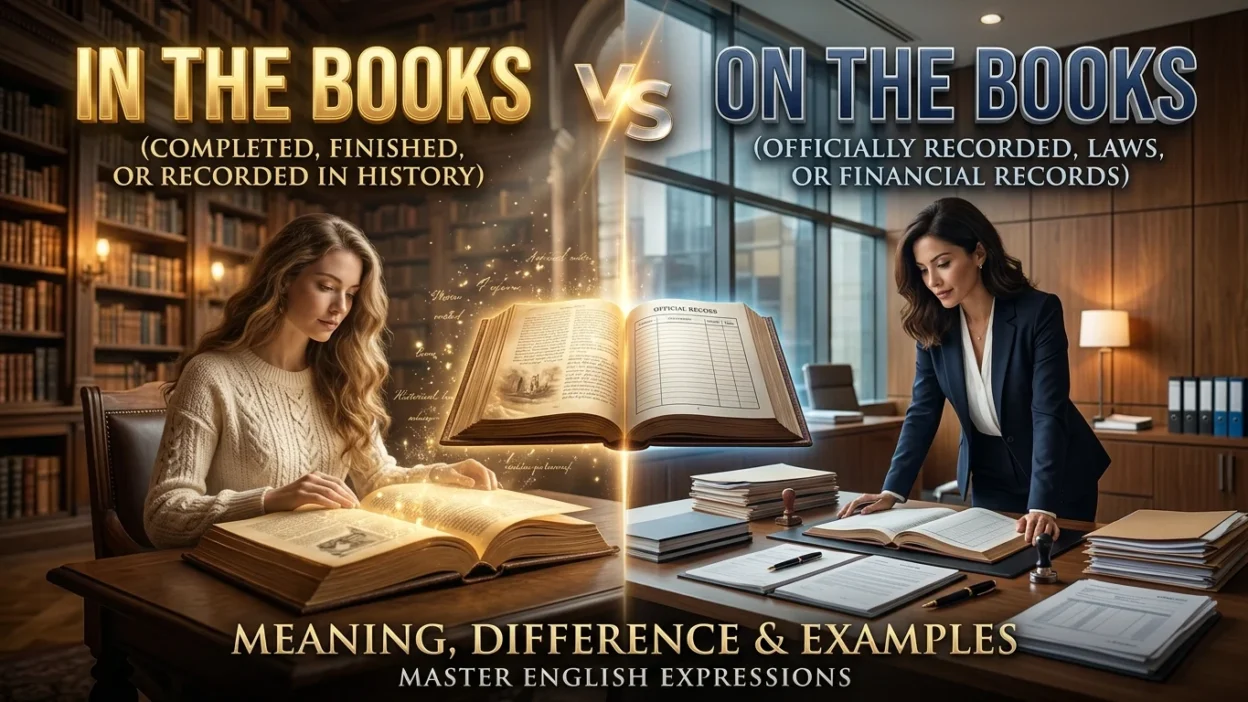
Have you ever wondered whether to say “in the books” or “on the books”? Both expressions are grammatically correct, but they have different meanings and uses. The phrase “in the books” can refer to something written inside books, officially recorded or completed, depending on the context. On the other hand, “on the books” commonly refers to something officially recorded in a register, list or account or to a law that is formally established.
Understanding the difference between these expressions can help you communicate more clearly and avoid confusing your readers. Both phrases are used in everyday English, professional conversations, academic writing, and business settings. In this guide, you will learn their meanings, differences, grammatical uses and practical examples. You will also discover common mistakes, useful memory tricks and answers to frequently asked questions so you can confidently use “in the books” and “on the books” in the right situations.
Quick Answer: In the Books vs On the Books
“In the books” generally refers to information contained within books or something completed and recorded, as in “The season is in the books.” “On the books” usually means officially listed, registered or legally established, as in “The law is still on the books.” The correct expression depends on the intended meaning.
Why Do People Confuse In the Books and On the Books?
People often confuse these expressions because both use the same noun, “books,” and the prepositions “in” and “on” can sometimes describe similar relationships.
However, English uses different prepositions to express different meanings.
- In the books: Suggests something inside written material or refers to something completed and recorded.
- On the books: Suggests something officially listed, registered, or legally established.
For example:
- The information is in the books. (The information appears in written material.)
- The old law is still on the books. (The law remains officially established.)
The difference becomes easier to understand when you consider the context.
1. What Does In the Books Mean?
In the books is an expression that can refer to information contained within written books, documents, or records. It can also appear in the idiomatic expression “in the books,” meaning that an event, task or period has been completed and is now part of the record.
Different Meanings of In the Books
1. Information Contained in Written Books
Use “in the books” when discussing information, facts, or stories found inside books.
Examples:
- The answer is in the books.
- You can find this information in the books.
- The story is described in several history books.
2. Something Completed or Finished
“In the books” is also used informally to describe something that has finished and can be considered part of the past.
Examples:
- Another successful year is in the books.
- The championship season is finally in the books.
- Our first project is officially in the books.
3. Something Recorded as Part of History
The phrase can describe an achievement, event or result that has become part of an official or historical record.
Examples:
- Her name is now in the history books.
- The team’s victory will go down in the books.
- This achievement belongs in the record books.
Examples of In the Books in Sentences
- The final chapter explains everything in the books.
- Another school year is officially in the books.
- His remarkable achievement will be remembered in the books.
- The details of the experiment are in the books.
- Our summer vacation is now in the books.
- The historic victory will go down in the books.
- The information is already available in the books.
- The successful event is officially in the books.
- This season will be remembered in the record books.
- Everything we learned is written in the books.
2. What Does On the Books Mean?
On the books is an idiomatic expression that generally means something is officially recorded, registered, or recognized in an organization, legal system, or financial record.
It is commonly used in business, law, employment, accounting and administration.
Different Meanings of On the Books
1. Officially Recorded
Use “on the books” when something is officially listed or documented.
Examples:
- Your name is on the books.
- The company has several employees on the books.
- The payment is already on the books.
2. Legally Established
In legal contexts, “on the books” refers to a law or regulation that remains officially established, even if it is rarely enforced.
Examples:
- The old regulation is still on the books.
- That law has been on the books for decades.
- Several outdated laws remain on the books.
3. Officially Employed or Registered
In business and employment contexts, the phrase can describe someone who is formally registered as an employee or associated with an organization.
Examples:
- She is on the books as a full time employee.
- The company has 200 workers on the books.
- He is officially on the books with the organization.
Examples of On the Books in Sentences
- The new regulation is now on the books.
- Her name is on the books as a registered member.
- The company has 50 employees on the books.
- The old law is still on the books.
- All financial transactions must be on the books.
- The organization keeps every registered employee on the books.
- The payment has been recorded on the books.
- Several outdated regulations remain on the books.
- The business has three new employees on the books.
- The agreement is officially on the books.
3. In the Books vs On the Books: Comparison Table
| Feature | In the Books | On the Books |
|---|---|---|
| Main meaning | Contained in written material or completed and recorded | Officially listed, registered, or established |
| Common usage | Writing, achievements, events | Business, law, employment |
| Grammar | Prepositional phrase | Prepositional phrase |
| Context | Books, history, completed activities | Official records and legal matters |
| Example | Another season is in the books. | The law is on the books. |
| Main idea | Inside or completed | Officially recorded or established |
The key difference: “In the books” often refers to something completed or contained in written material, while “on the books” usually refers to something officially registered or legally established.
4. When to Use In the Books vs On the Books
Choosing the right expression depends on what you want to communicate.
When to Use In the Books
Use “in the books” when referring to:
- Information found inside written books.
- A completed project, event, or activity.
- A finished season or year.
- An achievement that becomes part of history.
Examples:
- Our school project is finally in the books.
- The information is in the books.
- Another successful season is in the books.
- Her achievement will go down in the history books.
When to Use On the Books
Use “on the books” when referring to:
- Official records or registers.
- Registered employees or members.
- Financial transactions and accounting records.
- Laws and regulations that remain officially established.
Examples:
- The new policy is on the books.
- His name is on the books.
- The company has 100 employees on the books.
- The regulation is still on the books.
5. In the Books vs On the Books: 20+ Examples
The following examples will help you understand how both expressions work in different situations.
Examples Using In the Books
- Another successful year is in the books.
- Our final examination is now in the books.
- The championship season is officially in the books.
- Her remarkable achievement belongs in the history books.
- The information is available in the books.
- The project is finally in the books.
- This unforgettable journey is now in the books.
- The team’s victory will go down in the record books.
- The details are clearly explained in the books.
- Our biggest event of the year is in the books.
- The tournament is officially in the books.
- That historic moment will remain in the books.
Examples Using On the Books
- The new law is officially on the books.
- Her name is already on the books.
- The business has 25 employees on the books.
- The old regulation is still on the books.
- All company expenses should be on the books.
- He is listed on the books as a registered member.
- The organization has several volunteers on the books.
- The payment is now on the books.
- The agreement is officially on the books.
- Several old laws remain on the books.
- The company keeps all its workers on the books.
- The new policy is now on the books.
6. Common Mistakes When Using In the Books and On the Books
Although both expressions are correct, using one in place of the other can create confusion.
Here are some common mistakes and their corrections.
| Incorrect or Unnatural | Better Expression |
|---|---|
| The law is in the books. | The law is on the books. |
| Another season is on the books. | Another season is in the books. |
| The project is on the books. (when meaning completed) | The project is in the books. |
| The old regulation is in the books. | The old regulation is on the books. |
| The information is on the books. (when meaning inside textbooks) | The information is in the books. |
Important: Some sentences can use both expressions with different meanings. For example, “The information is in the books” means it appears in written material, while “The information is on the books” may suggest that it has been officially recorded in an organization’s records.
Always consider the intended meaning before choosing a preposition.
7. Easy Memory Trick to Remember In the Books vs On the Books
Here is a simple way to remember the difference.
In the Books = Inside or Finished
Think of something placed inside a book or an event that has been completed.
Examples:
- The answer is in the books.
- Another season is in the books.
On the Books = Officially Listed
Think of something written on an official register or recorded in an organization’s records.
Examples:
- The law is on the books.
- His name is on the books.
A Simple Rule to Remember
- IN = Inside written material or completed.
- ON = Officially recorded or established.
This simple memory trick can help you choose the correct expression in everyday conversations and writing.
8. American vs British English: In the Books vs On the Books
Both expressions are understood in American and British English. Their basic meanings are generally similar, although some usages may be more common in particular contexts.
| Expression | American English | British English |
|---|---|---|
| In the books | Used for completed events and recorded achievements | Understood and used similarly |
| On the books | Common in business and legal contexts | Common in business and legal contexts |
| In the record books | Used for historical achievements | Used for historical achievements |
| On the payroll | Used for registered employees | Also commonly used |
There is no major spelling difference between American and British English for these expressions.
9. Similar Expressions to In the Books and On the Books
English has several expressions related to books, records, and official documentation.
| Expression | Meaning | Example |
|---|---|---|
| In the record books | Recorded as an important achievement | Her performance is in the record books. |
| By the book | Following rules exactly | He always works by the book. |
| Cook the books | Falsify financial records | The company was accused of cooking the books. |
| Hit the books | Study seriously | I need to hit the books tonight. |
| Balance the books | Make financial records agree | The accountant balanced the books. |
| Close the books | Finalize financial records | The business closes its books annually. |
| Booked up | Fully occupied or scheduled | The hotel is booked up. |
| Off the books | Not officially recorded | The payment was made off the books. |
| In someone’s good books | Be viewed favorably by someone | She is in her teacher’s good books. |
| Go down in history | Be remembered for an important event | The victory will go down in history. |
10. Final Verdict: In the Books vs On the Books
Both “in the books” and “on the books” are correct English expressions, but they communicate different ideas.
- In the books: Used for information contained in books or events and activities that have been completed and recorded.
- On the books: Used for things officially registered, documented or legally established.
For example:
- Another successful year is in the books.
- The new law is on the books.
Remember that the correct preposition depends on the context. Understanding the difference will help you use both expressions naturally and confidently.
11. Frequently Asked Questions (FAQs)
1. Is it in the books or on the books?
Both expressions are correct, but they have different meanings. “In the books” often refers to something completed or contained in written material, while “on the books” means officially recorded, registered, or legally established.
2. What does in the books mean?
“In the books” can mean something is contained in written material. It is also an informal expression meaning an event, activity, or period has been completed and recorded. For example: Another successful season is in the books.
3. What does on the books mean?
“On the books” means something is officially recorded, registered, or legally established. It is commonly used in business, employment, accounting, and legal contexts. For example: The new regulation is on the books.
4. Is another year in the books or on the books?
“Another year is in the books” is the natural expression when you mean that the year has finished. It suggests that the year’s events are complete and part of the past.
5. What does still on the books mean?
“Still on the books” means something remains officially recorded or legally established. It is often used when discussing laws, regulations, policies, or formal records.
6. Is in the record books the same as in the books?
Not exactly. “In the record books” usually refers to an achievement or event recorded as part of history or official records. “In the books” has broader meanings, including something completed or information contained in written material.
7. What is the difference between on the books and off the books?
“On the books” means something is officially recorded or documented. “Off the books” means something is not officially recorded, often in financial or employment contexts. For example, an officially documented payment is on the books, while an undisclosed payment may be off the books.
Remember This
- In the books: Inside written material or something completed and recorded.
- On the books: Officially listed, registered, or legally established.
- Both expressions are grammatically correct.
- The intended meaning determines which preposition to use.
- “Another season is in the books” means the season has finished.
- “The law is on the books” means the law remains officially established.
Conclusion
Understanding the difference between “in the books” and “on the books” can improve your English vocabulary and help you communicate more accurately. Although both expressions contain the word “books,” their meanings depend on the prepositions used. “In the books” often describes information found in written material or something that has been completed. In contrast, “on the books” refers to something officially recorded, registered or legally established.
The easiest way to remember the difference is to connect “in” with something inside a book or a completed event, and “on” with official records and established rules. Practice these expressions in everyday sentences, pay attention to their context and you will soon use them naturally and confidently.