
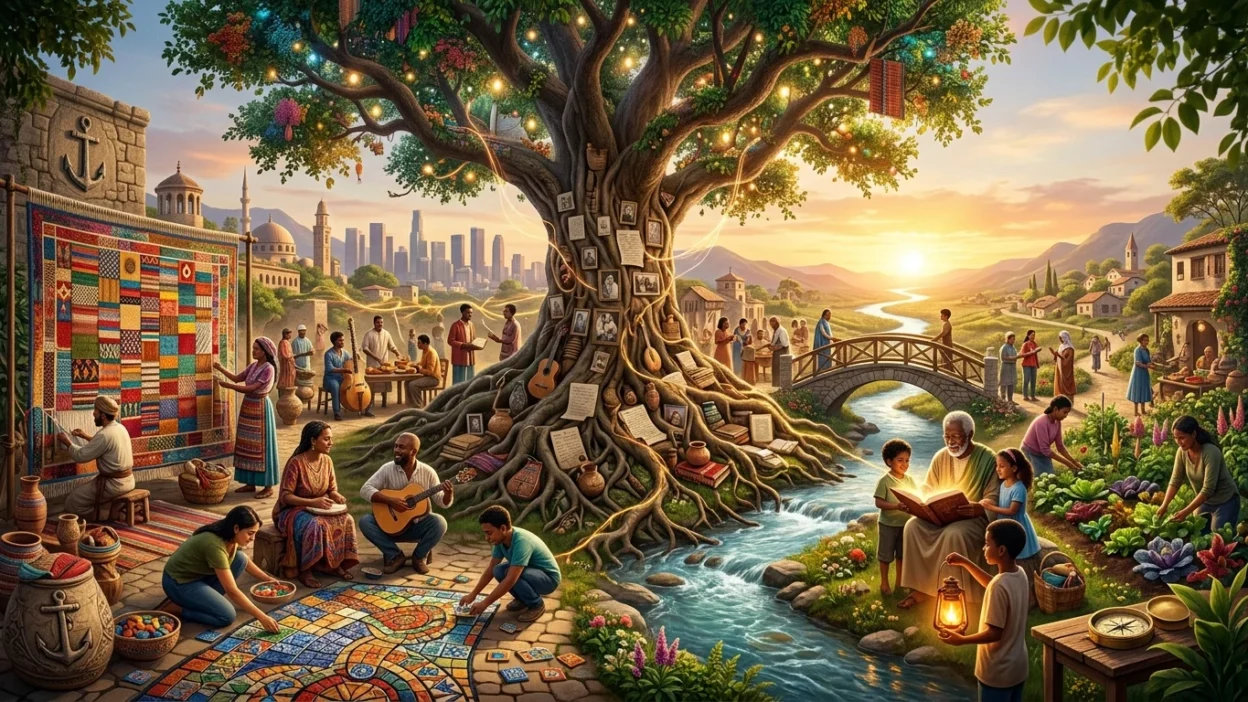
Culture is the collection of traditions, beliefs, values, stories, language, customs, art, food and ways of life that shape a community. It can be difficult to describe because culture is something people live, share, protect, and pass from one generation to another.
Metaphors make this abstract idea easier to understand. Culture can be described as a tree, a tapestry, a river, a bridge, a mirror, a garden or a living book. Each metaphor highlights a different part of what makes culture meaningful and lasting.
Quick Answer
A metaphor for culture directly compares culture to something familiar that represents identity, history, connection, or growth. Examples include “Culture is a tree with deep roots,” “Culture is a tapestry,” “Culture is a bridge between generations,” and “Culture is a living book.” These metaphors make cultural ideas vivid and memorable.
What Are Metaphors for Culture?
A metaphor describes one thing by saying it is another thing, without using “like” or “as.”
For example:
Culture is a tapestry.
This metaphor suggests that culture is made from many different threads—traditions, languages, beliefs, stories, foods, arts, and experiences—that come together to create something meaningful.
100+ Metaphors for Culture
| Metaphor | Meaning | Example Sentence |
|---|---|---|
| A tree | Culture has deep roots and continues to grow | Culture is a tree with deep roots and new branches. |
| A tapestry | Many traditions create one identity | Culture is a tapestry woven from countless stories. |
| A river | Culture flows from one generation to another | Culture is a river carrying history into the future. |
| A bridge | Culture connects people and generations | Culture is a bridge between generations. |
| A garden | Culture grows through care | Culture is a garden that communities must nurture. |
| A living book | Culture contains generations of stories | Culture is a living book written by its people. |
| A mirror | Culture reflects identity | Culture is a mirror of a community’s values. |
| A fingerprint | Every culture has unique features | Culture is a fingerprint that gives a community its identity. |
| A mosaic | Different parts form a larger whole | Culture is a mosaic of traditions and experiences. |
| A woven blanket | Culture provides belonging and comfort | Culture is a woven blanket connecting generations. |
| A foundation | Culture shapes identity and society | Culture is the foundation beneath a community. |
| A compass | Culture can guide behavior and values | Culture is a compass that helps people find direction. |
| An anchor | Culture connects people to their history | Culture is an anchor holding people to their roots. |
| A lighthouse | Culture preserves wisdom and guidance | Culture is a lighthouse shining through history. |
| A seed | Culture carries potential into the future | Culture is a seed planted by previous generations. |
| A root system | Culture connects people to their past | Culture is a root system beneath a community. |
| A branch | Cultural traditions can develop and diversify | Every tradition is a branch of the cultural tree. |
| A flame | Culture can be passed from generation to generation | Culture is a flame handed from one generation to another. |
| A torch | People carry culture forward | Culture is a torch carried through time. |
| A heartbeat | Culture gives a community life | Culture is the heartbeat of a community. |
| A song | Culture carries stories and emotions | Culture is a song sung across generations. |
| A language | Culture expresses identity | Culture is a language spoken through traditions. |
| A recipe | Culture combines many ingredients | Culture is a recipe made from history, values, and traditions. |
| A kitchen | Culture brings people together | Culture is a kitchen where memories are prepared and shared. |
| A feast | Culture celebrates shared identity | Culture is a feast of traditions and stories. |
| A treasure chest | Culture preserves valuable traditions | Culture is a treasure chest filled with history. |
| A museum | Culture preserves the past | Culture is a museum of collective memory. |
| An archive | Culture stores memories and knowledge | Culture is an archive carried by people. |
| A library | Culture holds generations of knowledge | Culture is a library of human experience. |
| A map | Culture shows where people come from | Culture is a map of a community’s journey. |
| A road | Culture carries traditions forward | Culture is a road connecting past and future. |
| A pathway | Culture shapes how people move through life | Culture is a pathway through shared experience. |
| A home | Culture creates belonging | Culture is a home carried within the heart. |
| A family album | Culture preserves shared memories | Culture is a family album filled with generations of stories. |
| A photograph | Culture captures moments from the past | Culture is a photograph of collective memory. |
| A quilt | Culture combines many individual stories | Culture is a quilt stitched from countless lives. |
| A necklace | Traditions connect generations | Culture is a necklace of traditions. |
| A chain | Culture links people across time | Culture is a chain connecting past and future. |
| A thread | Culture connects individual experiences | Culture is a thread running through generations. |
| A web | Culture connects people and ideas | Culture is a web of shared meanings. |
| A network | Culture connects communities | Culture is a network of relationships and traditions. |
| A conversation | Culture is continually shared | Culture is a conversation between generations. |
| A classroom | Culture teaches values and customs | Culture is a classroom without walls. |
| A teacher | Culture passes knowledge forward | Culture is a teacher that speaks through tradition. |
| A storyteller | Culture preserves collective memories | Culture is a storyteller carrying old tales forward. |
| A stage | Culture gives communities a way to express themselves | Culture is a stage for shared identity. |
| A canvas | People continually shape culture | Culture is a canvas painted by generations. |
| A painting | Culture combines many influences | Culture is a painting made from many colors. |
| A sculpture | Culture is shaped over time | Culture is a sculpture carved by history. |
| A kaleidoscope | Culture changes while remaining diverse | Culture is a kaleidoscope of traditions and perspectives. |
| An orchestra | Different traditions can create harmony | Culture is an orchestra of many voices. |
Metaphors for Cultural Identity
Culture is closely connected to identity. These metaphors work well when writing about who people are and where they come from:
- Culture is a fingerprint.
- Culture is a mirror.
- Culture is a home.
- Culture is a tree with deep roots.
- Culture is a family album.
- Culture is a woven blanket.
- Culture is a compass.
- Culture is an anchor.
- Culture is a living book.
- Culture is a mosaic.
Example Sentences
Culture is a fingerprint, giving every community its own identity.
Our culture is a tree, with traditions as its roots and new ideas as its branches.
Culture is a home we carry wherever we go.
Metaphors for Cultural Diversity
When describing many cultures coming together, try:
- A mosaic
- A tapestry
- A kaleidoscope
- An orchestra
- A garden
- A rainbow
- A quilt
- A marketplace
- A woven blanket
- A constellation
For example:
The city is a cultural mosaic, with every community adding its own color.
Humanity is an orchestra of cultures, with every tradition contributing a different voice.
Metaphors for Culture and Tradition
Traditions can be described as things that travel through time:
- A torch
- A flame
- A river
- A thread
- A chain
- A bridge
- A seed
- A recipe
- A family album
- A living book
Example Sentences
Tradition is a torch passed from one generation to the next.
Culture is a river carrying the stories of our ancestors toward the future.
Metaphors for Culture and History
When focusing on the past, use:
- A museum
- An archive
- A library
- A family album
- A photograph
- A treasure chest
- A time capsule
- A historical map
- An ancient tree
- A memory
Example:
Culture is a living archive of everything a community has experienced.
Metaphors for Culture and Food
Food is often an important part of cultural identity. You can describe culture as:
- A recipe
- A feast
- A kitchen
- A shared table
- A spice box
- A cookbook
- A family meal
- A garden
- A harvest
- A platter
Example:
Culture is a family recipe, with each generation adding something of its own.
Common Mistakes
- Don’t use “like” or “as” in a direct metaphor.
- ❌ Culture is like a tree.
- ✅ Culture is a tree.
- Choose a metaphor that matches your message.
- Use tree for growth and roots.
- Use tapestry for diversity.
- Use bridge for connection.
- Use archive for history.
- Don’t suggest that a culture never changes.
- Many cultures preserve traditions while also adapting and developing.
- Avoid treating one metaphor as a complete definition.
- A culture can be both a tree with roots and a river that changes over time.
Similar Expressions
- Cultural heritage
- Shared identity
- Way of life
- Cultural roots
- Living tradition
- Shared heritage
- Collective memory
- Cultural identity
- Common traditions
- Community values
- Cultural legacy
- Heritage passed down
- Shared history
- Traditions and customs
- Cultural fabric
Practice Questions
Fill in the blanks.
- Culture is a ________ with deep roots and growing branches.
- Culture is a ________ woven from many traditions.
- Culture is a ________ connecting generations.
- Culture is a ________ that reflects community identity.
- Culture is a ________ carrying history into the future.
- Culture is a ________ that preserves collective memories.
- Culture is a ________ of different traditions and perspectives.
- Culture is a ________ passed from one generation to another.
- Culture is a ________ that gives people a sense of belonging.
- Culture is a ________ combining many ingredients from history.
Answers
- tree
- tapestry
- bridge
- mirror
- river
- living book
- mosaic
- torch
- home
- recipe
FAQs
What is a metaphor for culture?
A metaphor for culture compares culture to something that represents identity, history, connection, or growth. Examples include “Culture is a tree,” “Culture is a tapestry,” and “Culture is a living book.”
What is a good metaphor for cultural diversity?
“Culture is a mosaic” is a strong metaphor because it shows how different traditions and identities can come together to form a larger whole.
What is a metaphor for cultural heritage?
“Cultural heritage is a torch passed from generation to generation” suggests that people preserve valuable traditions and carry them into the future.
What is a metaphor for cultural identity?
“Culture is a fingerprint” is an effective metaphor because it emphasizes the unique characteristics that help define a community or group.
What is a metaphor for tradition?
“Tradition is a thread connecting generations” shows how customs and values can link people to their ancestors and descendants.
Why are metaphors useful for describing culture?
Culture is a broad and abstract idea. Metaphors give it concrete images, helping readers understand how culture can grow, connect, preserve, guide, reflect, and evolve.
Conclusion
Metaphors for culture help turn an abstract idea into something readers can see and feel. Culture can be a tree with deep roots, a tapestry of traditions, a river carrying history, a bridge between generations, a living book, a mirror of identity or a mosaic of different voices.
These creative comparisons are useful in essays, speeches, poetry, stories, social studies assignments, cultural discussions, and creative writing. Choose the metaphor that best matches the part of culture you want to highlight.